It’s for you if
- You’re a rep who wants something better than improvising.
- You manage a team and want everyone working from the same frames, with a way to drill them.
- Your new reps lose doors before they’ve said what they’re there for, or at “not interested”.
What your reps actually hear
Eight sections, one for each of these, in the words a rep hears them:
- Price (page 5): “It’s too expensive.”
- Timing (page 7): “Not right now.”
- The decision-maker (page 8): “I need to talk to my wife.”
- The renter (page 10): “I rent, so I can’t.”
- Skepticism (page 11): “Is this a scam?”
- Not interested (page 13): “We’re good, thanks.”
- I already have that (page 15): “We’ve got someone.”
- No time (page 16): “I’m on my way out.”
Each gets the same treatment: what it sounds like, what’s underneath it, the frame, three ways to say it (short, warm, direct), the instinctive response that kills the conversation, and a question that reopens it.
How buying works
- Pay on Stripe. The checkout shows Holt Ventures LC, the company that publishes The Doorstep Playbook.
- Your download page opens as soon as the payment goes through.
- Print the pocket cards on page 26 at actual size, and set the lock-screen image on your phone.
Inside it, page by page
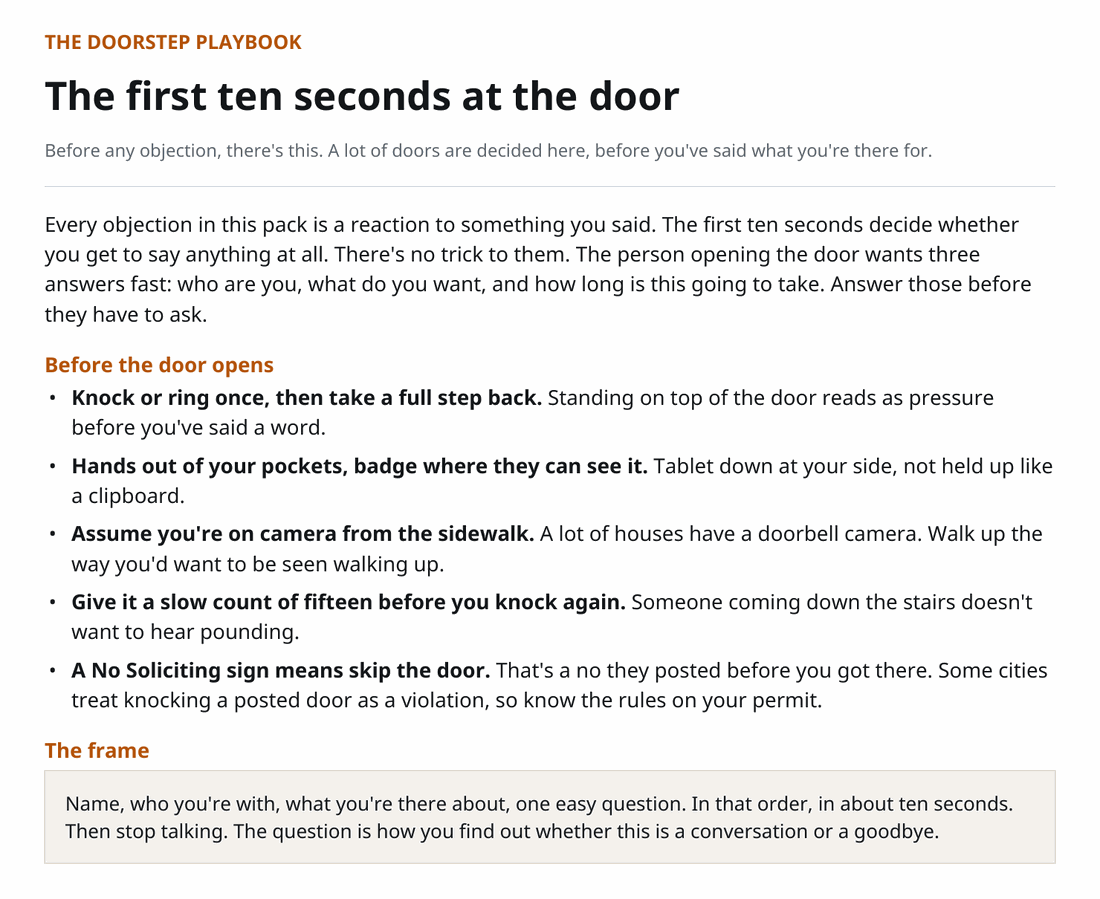
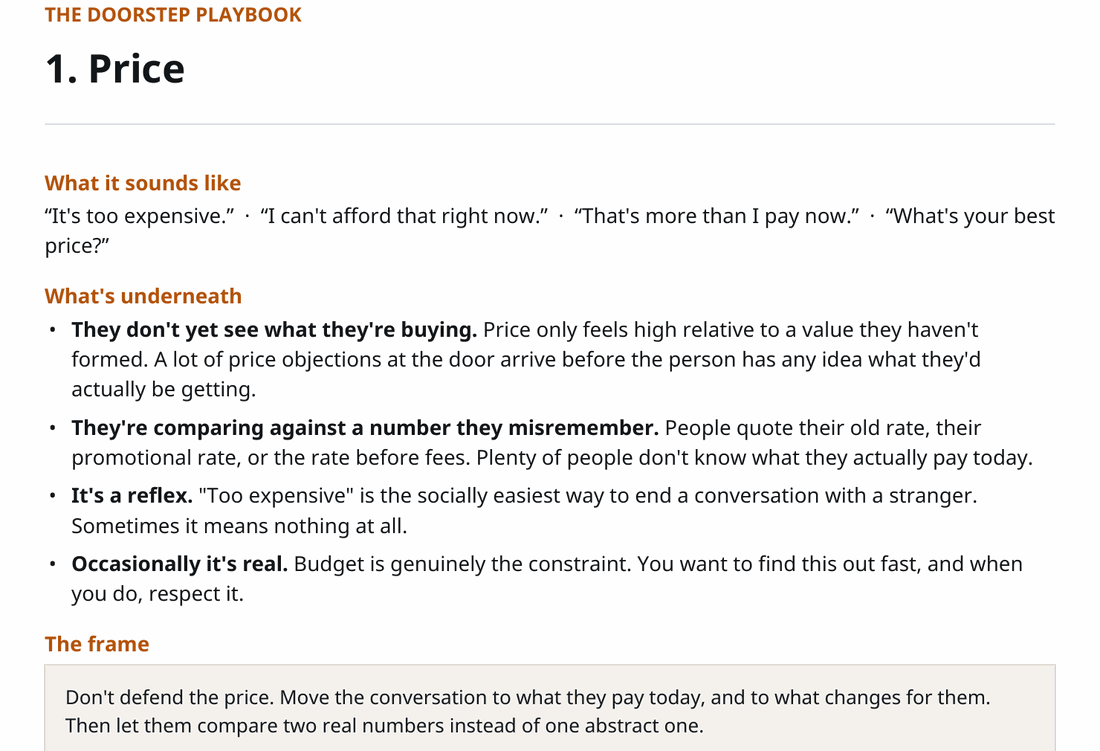
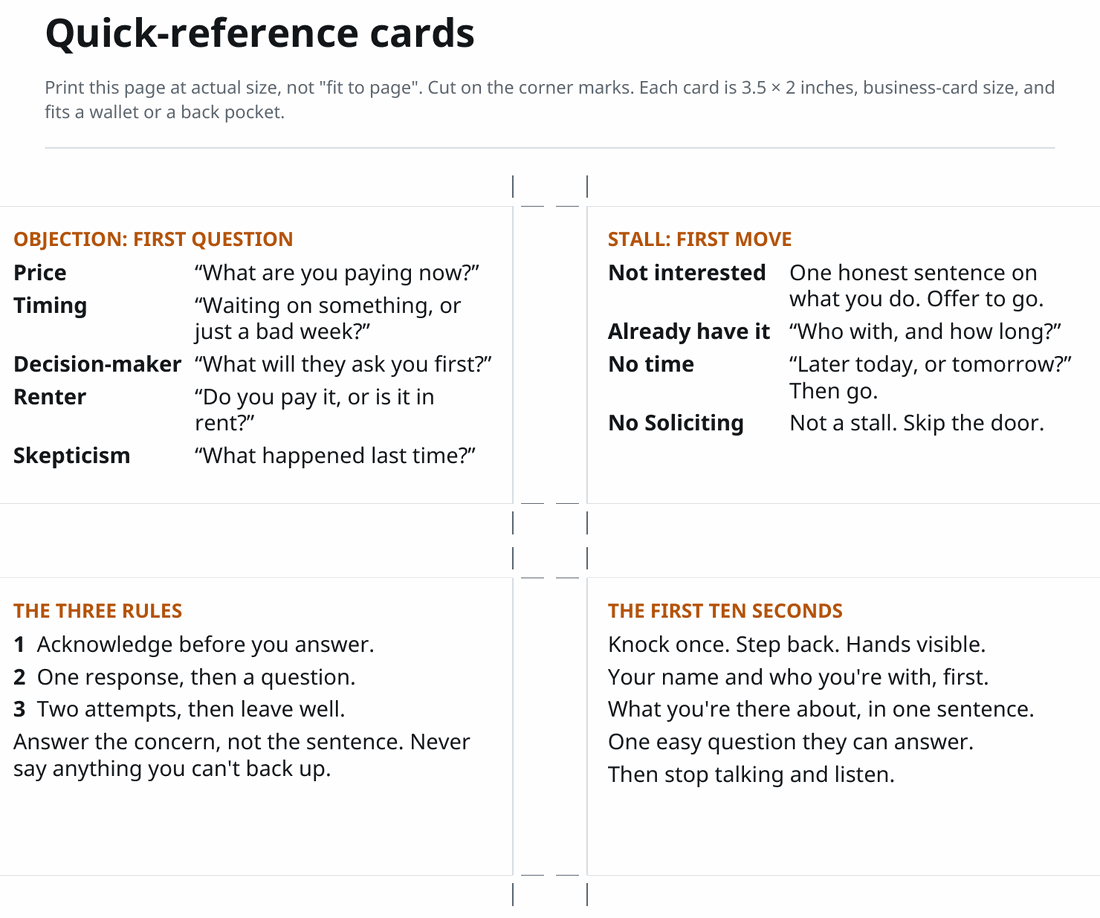
Rendered from the PDF itself. Tap a page to open it full size.
Read one full objection first
The free sample is the complete Timing section, section 2 of 8, as a two-page PDF. The wording is exactly what’s in the paid PDF, with one line added at the end naming the product. It has what it sounds like, what’s underneath, the frame, three ways to say it, what kills it, and the reopener. It’s free and nobody asks for your email. The button opens the PDF.
Instant download · Refundable for 30 days, no questions asked
Why it isn’t a script
A script you memorize word-for-word will fail you, because the homeowner didn’t read it. What survives contact with a real door is a frame: a way of understanding what you just heard, and a direction to move in. The words are replaceable. The frame isn’t.
The core idea running through the whole pack: in my experience, a lot of objections at the door are a surface sentence covering a different concern. Answer the surface sentence and you win the sentence and lose the door. Answer the concern underneath and the surface sentence often dissolves on its own.
The five objections, and what’s under them
- Price. Usually not about the number. They don’t yet see what they’re buying, or they’re comparing against a number they misremember. Sometimes it’s a reflex; occasionally it’s real, and then you respect it.
- Timing. A real date, a polite no, or the hassle of switching. A timing objection with a date is a lead, and there’s a question that tells you which one you’ve got.
- The decision-maker. To me, the most legitimate objection on the list, and it often gets the least respect. Sometimes they just can’t explain it to the other person yet, and that one is fixable.
- The renter. They assume the decision isn’t theirs. Sometimes part of it is. If it’s genuinely the landlord’s call, the tenant becomes your introduction rather than your obstacle.
- Skepticism. The only objection where lowering your energy is the move. More enthusiasm is more pressure, and pressure is the thing they’re reacting to.
And the three stalls, with the same treatment
- Not interested. A reflex aimed at the situation, not your offer. The section covers the four versions you’ll meet: through a closed door, through a doorbell camera, while they’re already turning away, and at a No Soliciting sign, which isn’t a stall at all.
- I already have that. Usually true. Ask about the specific thing they have, then work out together whether there’s anything worth comparing. If there isn’t, say so and go.
- No time. Take them at their word: tell them the honest size of this and let them choose, or set a real time and leave.
Also in it
- The first ten seconds at the door (page 4), with the same frame, three ways to say it, and what kills it.
- Three rules that matter more than any script (page 3). Acknowledge before you answer. One response, then a question. Two attempts, then leave well.
- Getting these into your mouth (page 17): three steps for reps, from rewriting a response in your own words to saying it under pressure.
- A “make it yours” worksheet (pages 18–20): six blocks, each with room to rewrite a response in your own words and five “said out loud” boxes to tick.
- Drilling this with a team, for managers (page 21): the two-minute partner drill, what to correct and what to leave alone, and why a new rep shouldn’t get all eight in week one.
- 35 drill cards (pages 22–23), every phrasing from the eight sections, plus a drill score strip (page 24) and a one-week objection tally (page 25).
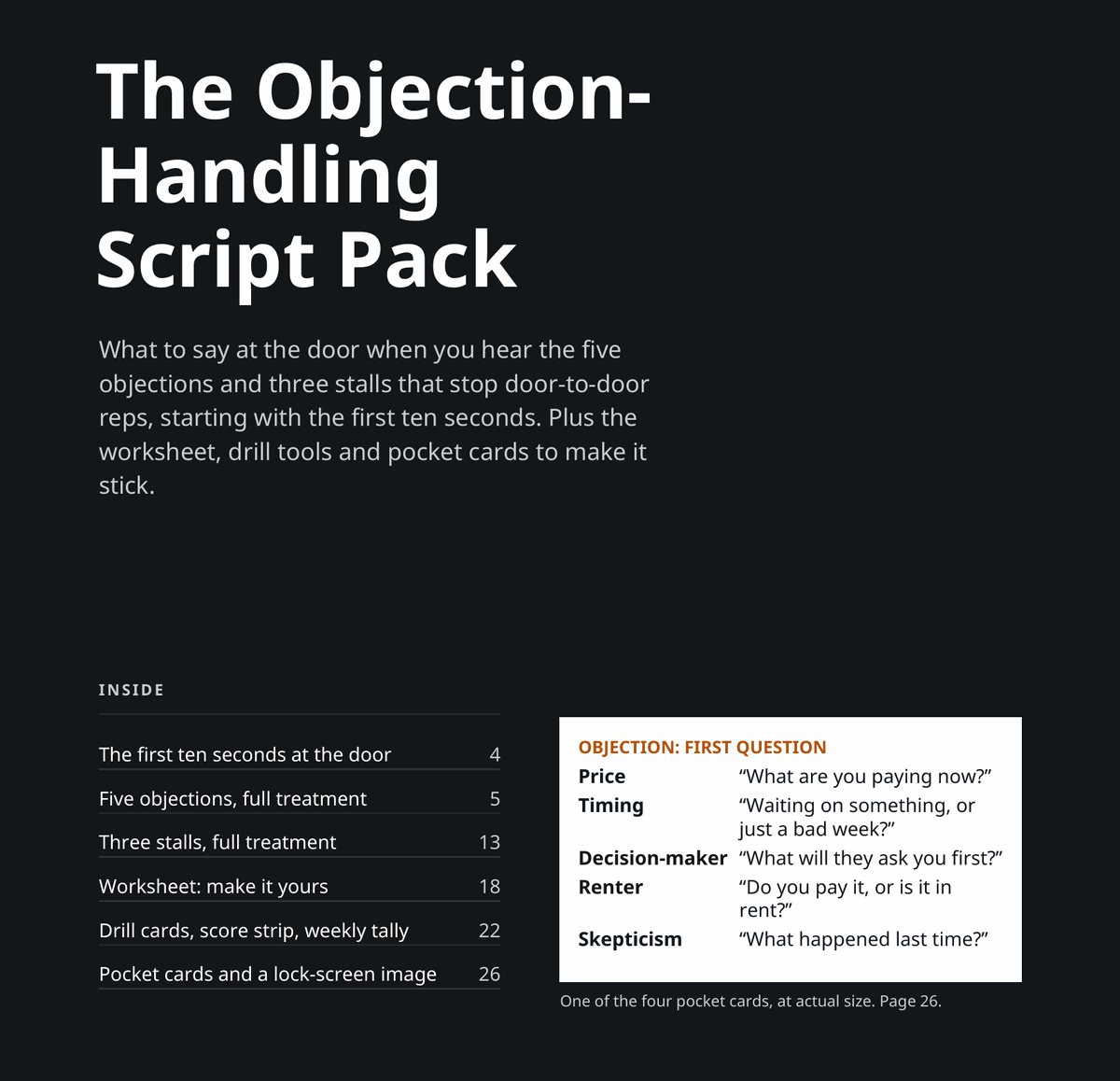
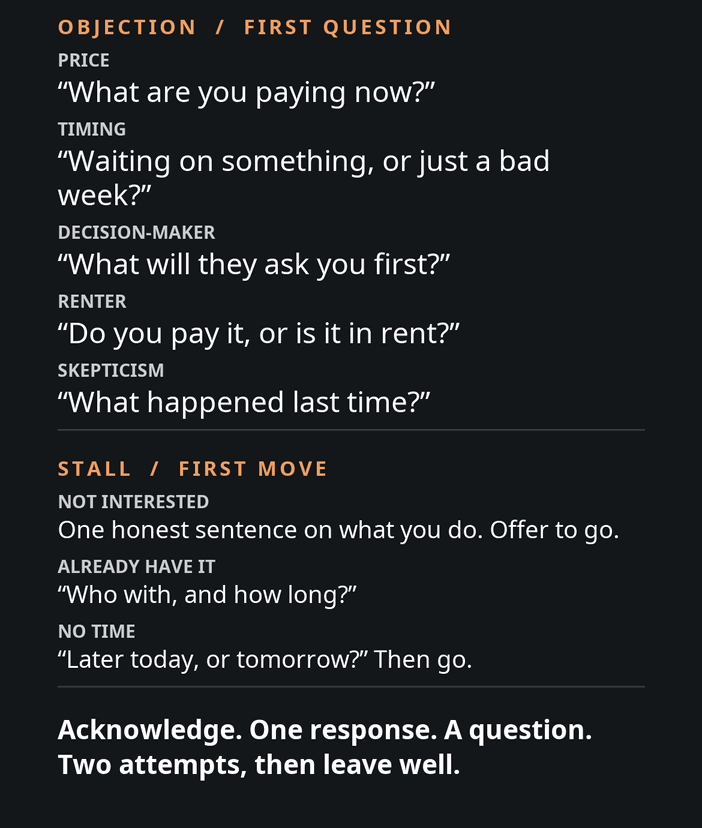
- Four pocket cards (page 26), 3.5 × 2 inches, with corner marks: the first question for each objection, the first move for each stall, the three rules, and the first ten seconds.
- A phone lock-screen image of the same first questions, in large type, as a separate file on your download page.
A page from it
What kills a price objection: dropping the price immediately. You’ve just told them the first number was fake, and everything you say afterward gets discounted too.
Watch for the tell: someone who asks a follow-up question after the price objection is negotiating, not declining. Someone who repeats the same sentence flatly is declining.
Section 1, Price, page 6.
And the card that goes in your pocket
Page 26 is four cards you cut out. The first has one line per objection: the objection, and the first thing out of your mouth. Two of the five, copied out of the file:
- Price — “What are you paying now?”
- Skepticism — “What happened last time?”
That’s the point of the card. A rep standing on a porch can’t read a page of reasoning, but he can remember one question, and the question is what buys him the thirty seconds in which the rest of the pack becomes useful.
Before you use it
Every response is general-purpose and written from scratch. You’re expected to put your own product’s language into it, and to change any wording that doesn’t sound like something you’d actually say. Where a bracket can’t be filled in truthfully for your offer, the pack tells you to cut the sentence.
It is not a substitute for your company’s required compliance language. Where they conflict, your compliance language wins.
Format and delivery
26-page PDF and a phone lock-screen image, available immediately after checkout. Print copies for your reps. Refundable for 30 days, no justification needed. See the refund policy.
Checkout is on Stripe and shows Holt Ventures LC, the company that publishes The Doorstep Playbook.
Want a sense of the thinking first? Read the At the Door articles, free.