Before you put reps on the doors of a city you have not worked, eight questions settle it. Ask them in this order, in one call to the office that issues the permit, and you will know whether the city is workable, what it costs, how long it takes, and which rule is most likely to get your team a complaint. Every question below earned its place because a real ordinance answered it differently from the city next door, and the examples are named so you can hear what a surprising answer sounds like before a clerk gives you one.
How to use it. Call the issuing office with this page open, write the answers into the blank sheet further down, and then read the sections yourself before you commit a team to the market. A clerk’s summary is fast and usually right; the section is what your reps are actually held to. This is orientation, not legal advice.
The eight questions
1. Is there a permit, and whose is it?
Ask: “Do I need a permit or registration for commercial door-to-door sales, and is it issued to the company, to each rep, or to both?”
Nashville wants both: a company permit and a personal ID badge for every rep. Boise’s code makes it unlawful to engage in the business “or to employ another in such business” without a license, which puts the duty on the manager rather than only on the rep. Las Vegas needs two documents per rep, a solicitor permit and a separate work card from a separate counter. Assume one permit covers the team and you will find out otherwise on a Monday morning.
2. Which counter issues it?
Ask: “Which department do I file with, and is any other office involved before it is issued?”
There is no standard answer to this and it is the cheapest week you will ever lose. Boise issues through the City Clerk. Fort Worth files with Development Services, not the police. San Antonio and Peoria register with the police department. Jacksonville’s permit comes through the Duval County Tax Collector rather than City Hall. Orlando begins with a fingerprinting appointment at the police department. Ask the question even when you are sure you know.
3. What does it cost, and which category am I in?
Ask: “What is the fee for the company, what is the fee for each rep, and which category does a rep who takes orders for later delivery fall under?”
The category question is the one that saves money. San Antonio prices a canvasser at $60 and a foot peddler at $120, and the line between them is whether the rep takes orders for later delivery or sells goods off his person. Fort Collins charges $200 for up to four solicitors and $300 for five or more, so the number moves with your headcount and you should quote the headcount you expect in October, not the one you have in June. Fort Worth charges nothing at all. Ask for both figures even when you expect only one of them to exist.
4. How long does it take, and what do I have to bring?
Ask: “How far ahead do I file, and is there a background check I have to obtain myself before I apply?”
This is the answer that sets your start date, and it is almost never the counter visit. San Antonio requires the application at least five days before the first contemplated sale. Salt Lake City, Provo and St. George all want a Utah Bureau of Criminal Identification report submitted with the application, and St. George wants the original, dated no more than 180 days before the application, with the cover page and seal. A background check is a queue, not a form, and for a team recruited out of state in April it is the long pole in the whole schedule.
5. What hours may we knock, and do they move?
Ask: “What are the permitted hours, and do they change with the season or with the day of the week?”
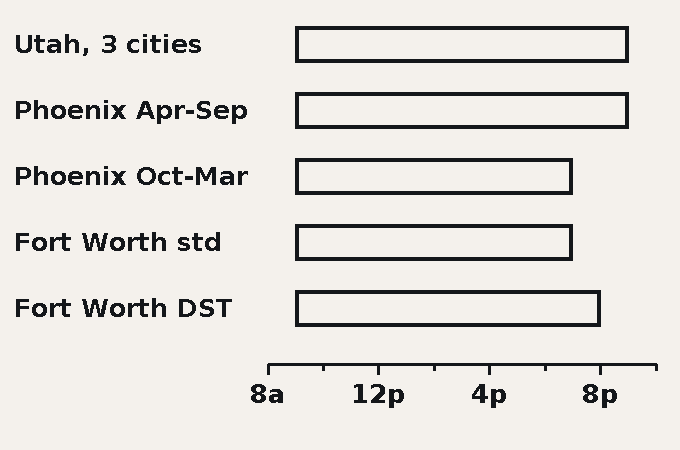
Phoenix runs 9 a.m. to 9 p.m. from April through September and 9 a.m. to 7 p.m. from October through March, so a schedule built on summer habit is wrong on 1 October. Boise ends one hour after sunset outside commercial zones, which in December closes the day before six. Dallas bars solicitation at any time on a Sunday and on ten named holidays. Fort Worth splits its own year between standard and daylight time. The three Utah cities that run the same model ordinance all set 9 a.m. to 9 p.m. and do not move.
6. What has to be on the rep, and where?
Ask: “Does the rep display something, carry something, or both, and does the rule say where on the person?”
Cities that bother to write this down are specific about it. Nashville requires the badge conspicuously displayed “on the front of his/her person” at all times while soliciting. Provo requires it “worn prominently on the solicitor’s person.” Fort Worth requires the registration certificate to be carried. Salt Lake City requires the permit carried on the person while engaged in face-to-face solicitation. Residents are told to look for these, so a rep who leaves the badge in the truck is the one who generates the phone call.
7. What is the sign rule, and is there a list?
Ask: “What does a posted sign oblige my reps to do, and does the city keep a do-not-knock list?”
Ask this separately from the permit question, because the two rules usually sit in different sections and the sign rule is the one that produces complaints. Dallas puts an affirmative duty on the rep to examine the premises for a sign reading “NO SOLICITORS OR HANDBILLS” before leaving anything, which means “I did not see it” is not a defense there. Fort Collins and Nashville both keep no-solicitation lists, and a list is not a sign: your reps cannot see it from the sidewalk, so it has to be handled in the office before the route is cut.
8. When does it expire, and where is it good?
Ask: “How long is it valid, and does it cover any neighboring city?”
Dallas expires one year after issuance. Fort Worth expires 180 days from issuance, which a spring hire runs into in the fall without warning. Nashville company permits run two years. West Valley City states plainly that its license is only valid within West Valley City, and it borders Salt Lake City, which runs a different ordinance entirely. Peoria requires registration for a rep who goes from house to house “or to only one (1) house,” so there is no threshold to slip under and no quick unlicensed test of a neighborhood. Cross a city line and the answer changes.
Before you hang up
Ask for the section numbers: the permit section, the hours section and the sign section. Write them down and read them the same day. The two sources rarely carry the same facts: Fort Worth’s own licensing page states the permitted hours and the 180-day expiry that its code section leaves out, while Orlando’s permit page cites no ordinance section at all. You want both, and you want to be able to quote the section back when a rep is stopped.
The sheet
Print this part, or copy it into a note. One sheet per city.
| City and state: | |
| Office and phone: | |
| Spoke to, and date: | |
| 1. Permit required? | Company ___ Rep ___ Both ___ |
| 2. Filed with: | |
| 3. Fee, company: | |
| per rep: | |
| my category: | |
| 4. File how far ahead: | |
| background check I must obtain: | |
| 5. Hours: | |
| seasonal or day-of-week changes: | |
| 6. Carried: | |
| displayed, and where: | |
| 7. Sign rule: | |
| city do-not-knock list: | |
| 8. Expires: | |
| valid outside this city: | |
| Sections to read myself: | |
| Verdict: | workable now ___ workable later ___ not this season ___ |
A filled-in example: Provo, Utah
Provo is the best-documented city on the sixteen-city reference, so it is the one where every line of the sheet can be filled from published sources. Anything a source did not state is written as not stated, which is what your own sheet should say too.
- 1. Permit required? Yes, per rep. A certificate from the Licensing Officer before soliciting, under Provo Code 6.09.060.
- 2. Filed with: the Licensing Officer, through Provo 311 Customer Service. The ID is verified in person (6.09.070), so the rep goes to the counter even after applying online. Where the badge photograph is taken is not stated on the city’s current pages.
- 3. Fee: $72 per solicitor plus $10 per identification badge, $82 per rep, from the city’s Consolidated Fee Schedule. Category not split. (This line said $76 until 13 September 2026, from a city page that no longer loads.)
- 4. Lead time: a BCI background check no more than 180 days old, or an equivalent check from the applicant’s home state, has to be in hand at application. A completed application gets a same-day answer on a temporary certificate, which lasts until the city decides on the annual one or for 25 calendar days, whichever is shorter (6.09.080; 6.09.100).
- 5. Hours: 9 a.m. to 9 p.m. Mountain, under 6.09.190, and the section binds exempt solicitors as hard as registered ones.
- 6. On the rep: the city badge worn prominently while soliciting, carrying the city’s name, the rep’s name and contact details, a recent photograph and the expiry date (6.09.110).
- 7. Sign rule and list: the ordinance carries a “No Solicitation” notice section. No city-kept do-not-knock list was found on the licensing pages.
- 8. Expiry and scope: the annual certificate runs one year from the day the temporary one was issued and expires at midnight on the anniversary (6.09.100(3)). Provo 6.09.020(1) says that a registered solicitor needs no other city license, so the certificate is the whole answer inside Provo.
- Sections to read: 6.09.060, 6.09.070, 6.09.100, 6.09.110, 6.09.190, 6.09.020(1). Re-checked 13 September 2026; the Provo permit page has every item a completed application needs.
Two lines came back blank on the best-documented city on the list. That is normal, and it is the point of writing them down: the blanks are your call-back list, not a reason to guess.
What to do next
If your city is one of the 252 already checked, the fastest route is the permit lookup — one card per city, and it answers questions 1 through 8 above in about ten seconds. Behind it sits the permit rules by city reference, which quotes the ordinance for each one and says plainly where a fact could not be confirmed. Then use this sheet for the questions those pages leave open. If your city is not on the list, this sheet is the whole method: one call, eight questions, then read the sections.
Every example on this page is drawn from the ordinance or the city’s own licensing page, checked between 4 and 6 September 2026 and quoted at length in that reference. Codes change. Check the date on anything you rely on, including this.
Get told when a rule changes
Cities amend these ordinances without telling anyone who knocks on their doors. Provo’s chapter is current through Ordinance 2026-17, passed 9 June 2026; fee schedules move with the budget year. Nobody sends a notice, so the only way to know is to check again.
One email when something new goes up here: a city added to the sixteen-city reference, a rule on it that changed, or a new article. That is all it is — no pitch, and unsubscribe in one click. This sheet and that reference stay free and public whether you subscribe or not.