It’s for you if
- You’re a first-time team lead with three reps, doing the recruiting, the onboarding and the coaching yourself.
- You’re rebuilding after a bad season, or you own the company and keep hiring into the same hole.
- You have no recruiter and no budget worth mentioning.
Industry-neutral by design: fiber and telecom, solar, pest, security, roofing. The problems it addresses are the same everywhere doors get knocked.
How buying works
- Pay on Stripe. The checkout shows Holt Ventures LC, the company that publishes The Doorstep Playbook.
- Your download page opens as soon as the payment goes through.
- Print the templates you need. Start with Part 1: its four questions take about twenty minutes to answer in writing.
Inside it, page by page
Rendered from the PDF itself. Tap a page to open it full size.
Try a real page first
The free sample is page 25 of the Playbook: Template 6, the weekly one-on-one, taken unchanged from the paid PDF. It’s one page, with five prompts, lines to write on under each, and a short list of things to watch for between one-on-ones. It’s free and nobody asks for your email. The button opens the PDF.
Instant download · Refundable for 30 days, no questions asked
The problem it’s aimed at
Turnover gets treated as a recruiting problem. It usually isn’t. It’s an onboarding and coaching problem that recruiting gets blamed for, which is why teams that churn respond by recruiting harder, put more people through the same broken first two weeks, and produce more churn at higher cost, with a worse name in a small local labor market every time around.
So this guide spends one part on finding people and four on keeping them. That ratio is deliberate.
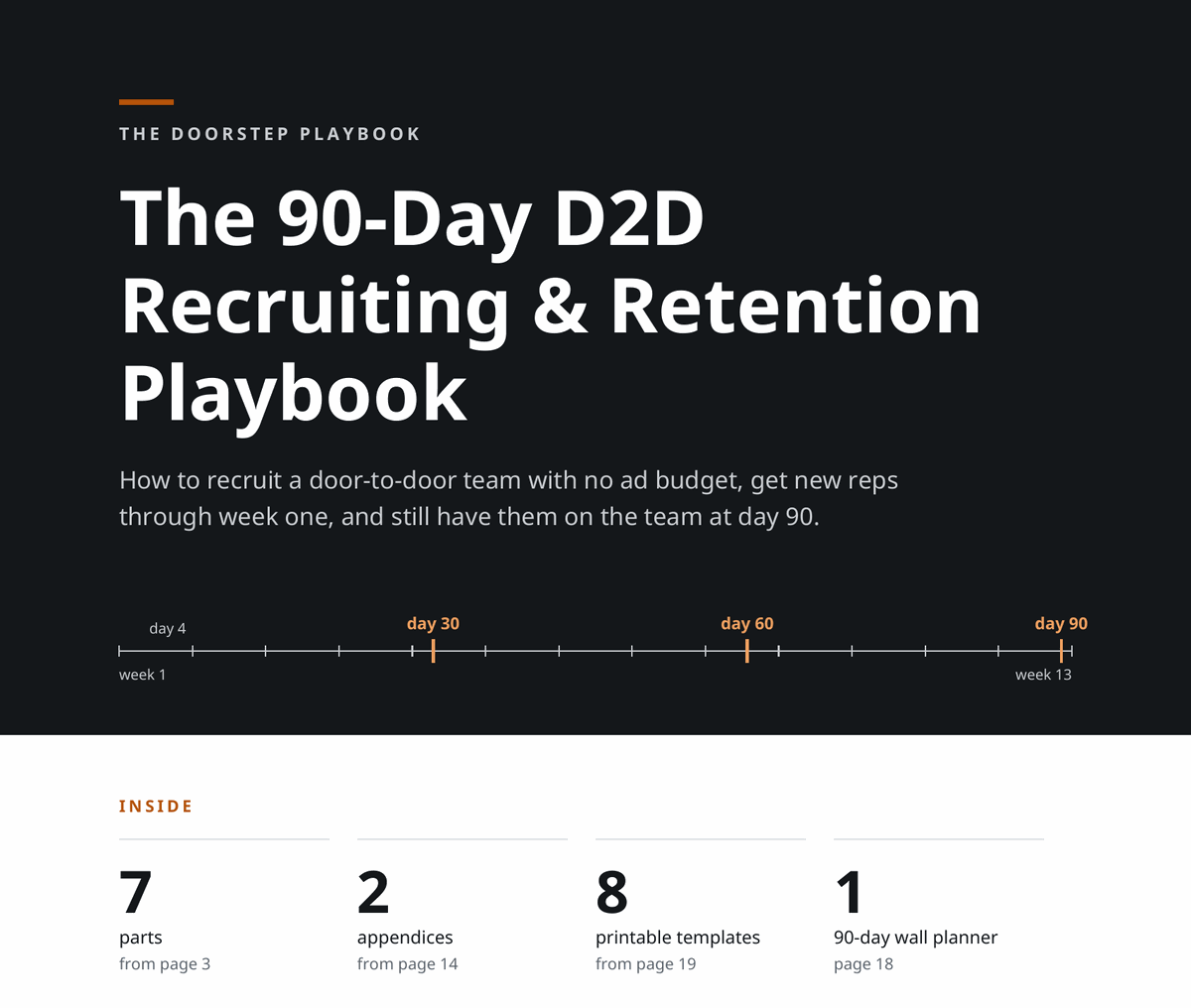
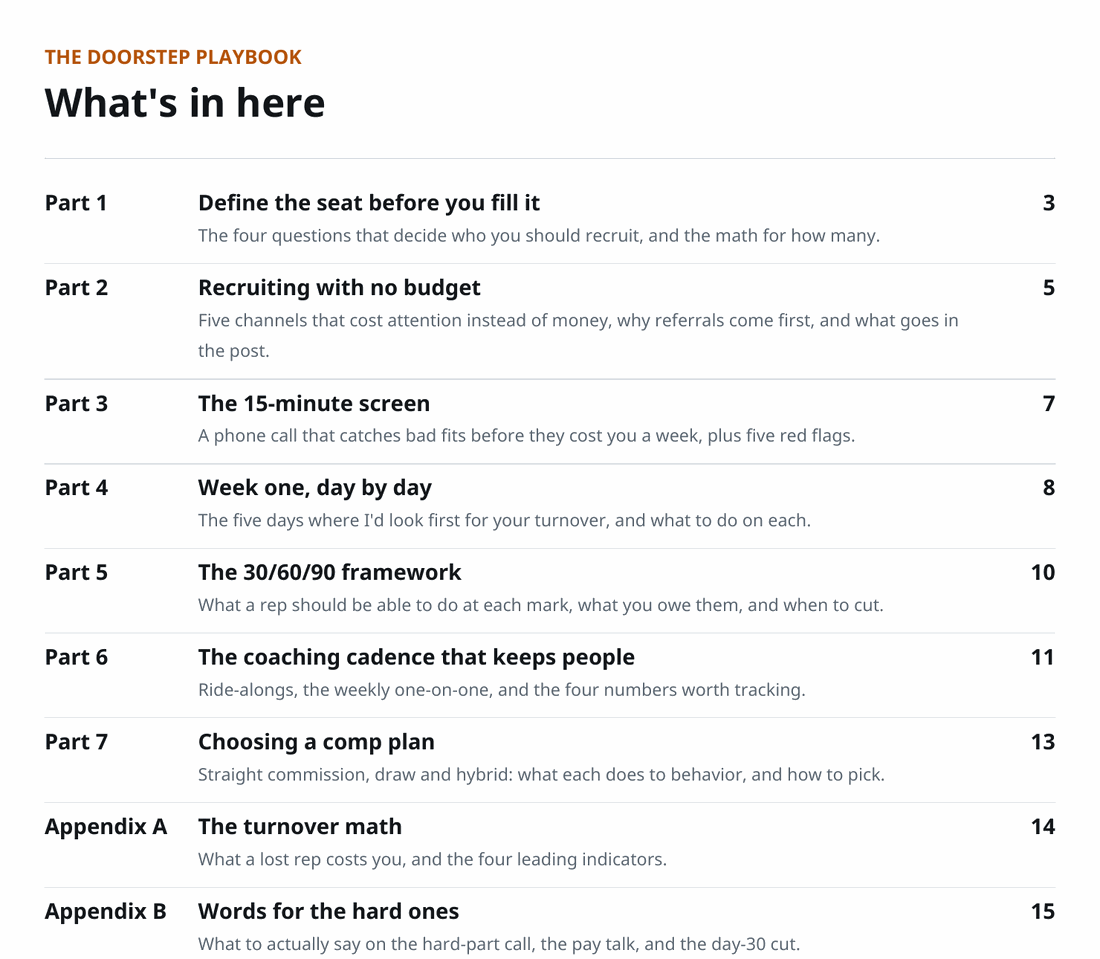
The seven parts and two appendices
- 1 — Define the seat before you fill it. The four questions to answer in writing before you post anything, and the math that tells you how many people you actually need in the door this month.
- 2 — Recruiting with no budget. Five channels that cost attention instead of money, in the order I’d work them, why referrals come first, and what goes in the post, including why the range you publish should come off your own payroll.
- 3 — The 15-minute screen. Six questions in order, what you’re listening for in each, five red flags, and the one thing you must do on that call.
- 4 — Week one, day by day. The five days where I’d look first for your turnover, including why I treat day four as the highest-risk day of the first ninety, and three sentences I’d say to every new rep in week one.
- 5 — The 30/60/90 framework. What a rep should be able to do at each mark, what you owe them, when to cut, and the activity-versus-results distinction that decides it.
- 6 — The coaching cadence that keeps people. Ride-alongs, the fifteen-minute weekly one-on-one, the four numbers worth tracking, and the things that keep people that aren’t money.
- 7 — Choosing a comp plan. Straight commission, draw and hybrid: what each does to behavior, and four questions that pick one for you.
- Appendix A — The turnover math. What a rep lost at day 25 costs you, line by line, and the four leading indicators that move before someone quits.
- Appendix B — Words for the hard ones. What to actually say on the hard-part call, the “here’s exactly how you’re paid” talk, and the day-30 cut, each with what not to say.
Eight templates and a wall planner
The printables start on page 18. Each one is built to be printed on its own and filled in by hand, with room to write.
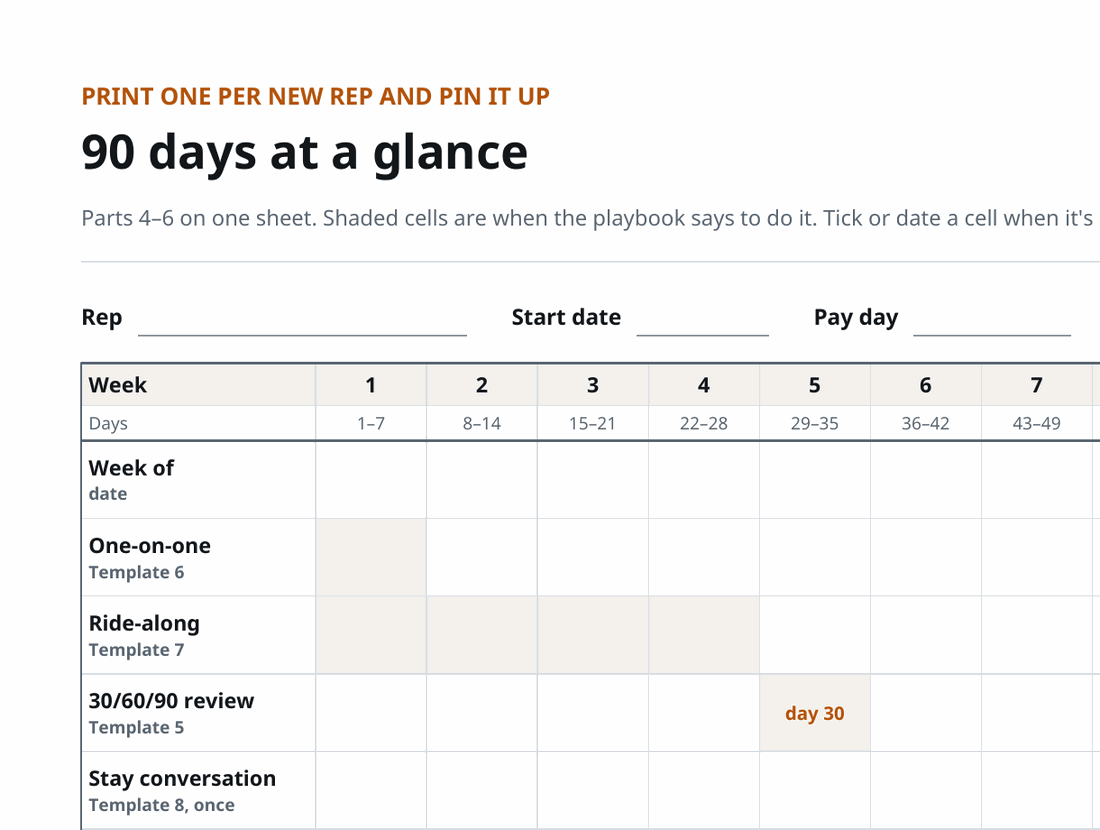
- 90 days at a glance (page 18) — one landscape sheet per new rep: weeks 1 to 13 across, rows for one-on-ones, ride-alongs, the 30/60/90 reviews, the stay conversation, pay, doors per day and sales, with the weeks the guide calls for shaded.
- 1. The seat definition (pages 19–20) — the four questions, then the headcount math on its own page.
- 2. The job post (page 21) — a full version and a short one, as plain text you can copy. The same text is on your download page, ready to paste.
- 3. The 15-minute phone screen (page 22) — one sheet per candidate: six questions with what to listen for, notes, red flags to tick and a decision.
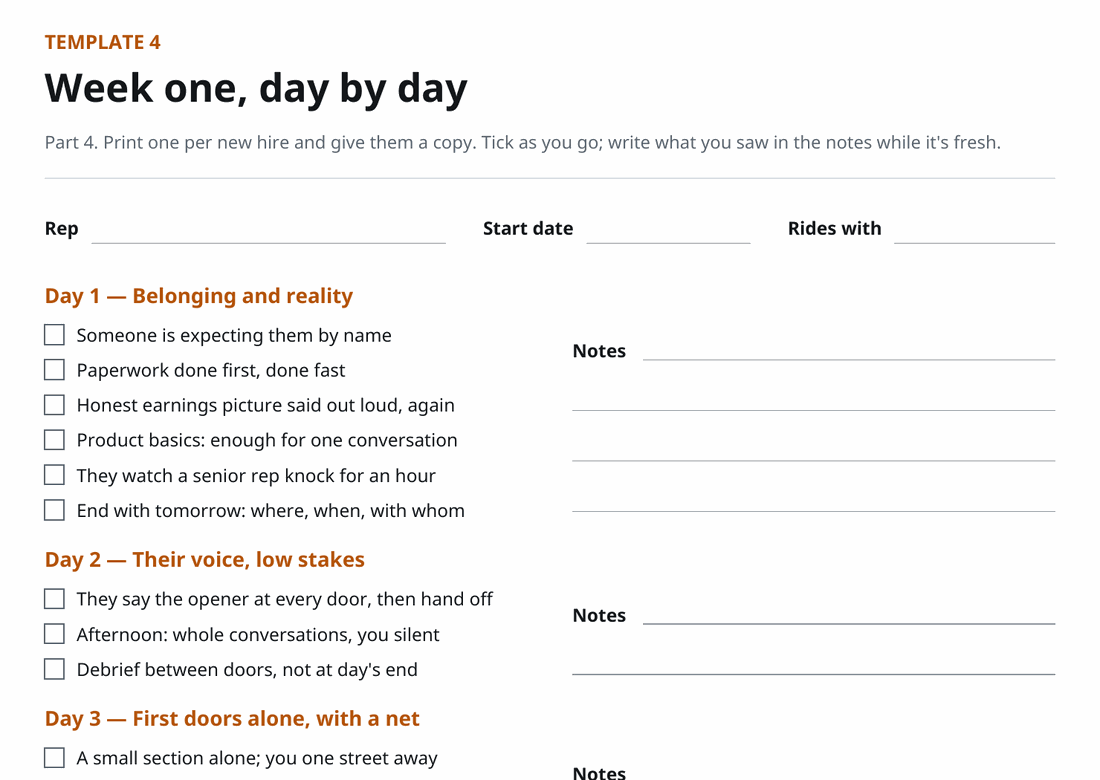
- 4. Week one, day by day (page 23) — a checklist per day with room for notes. Print one per new hire and give them a copy.
- 5. The 30/60/90 review (page 24) — their numbers against the team’s, the activity-versus-results box, the conversation, and a decision to tick.
- 6. The weekly one-on-one (page 25) — fifteen minutes, five prompts, and the four warning signs to watch for between them.
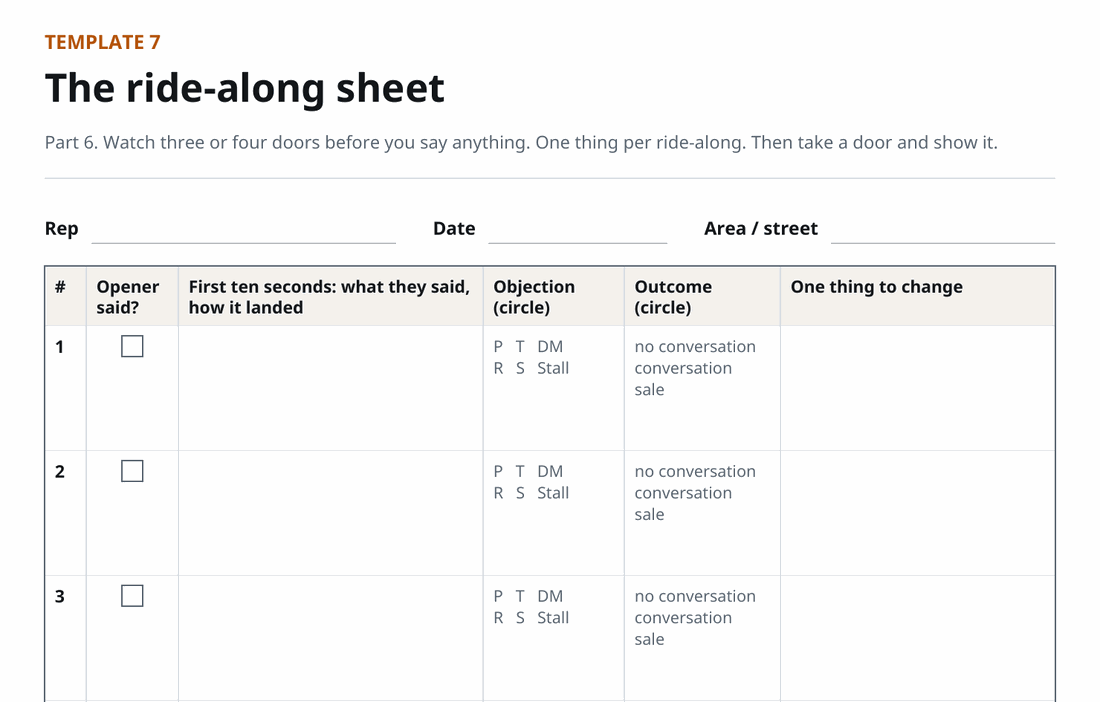
- 7. The ride-along sheet (page 26) — six doors, what the first ten seconds sounded like, the objection and outcome to circle, and a five-minute debrief.
- 8. The stay conversation (page 27) — five questions for a rep who isn’t leaving, and the one thing you’ll fix, by a date.
What the headcount page does
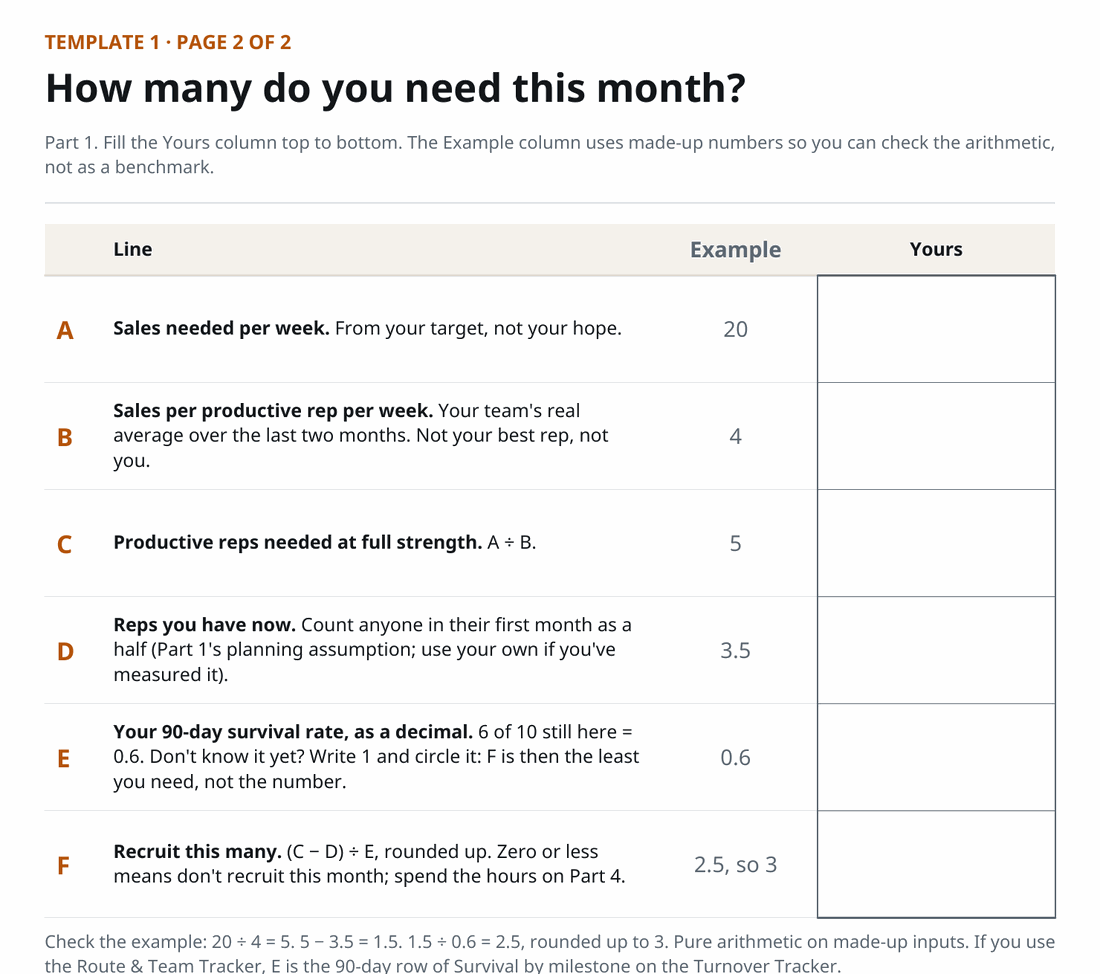
Page 20 is six lines, A to F, and it’s the reason the first template exists. The page’s own example uses made-up numbers so you can check the arithmetic: you need 20 sales a week, a productive rep averages 4, so you need 5 productive reps at full strength. You have 3.5, counting anyone in their first month as a half. If 6 of every 10 people you hire are still here at 90 days, write 0.6.
Then (5 − 3.5) ÷ 0.6 = 2.5, rounded up: recruit 3 this month. Leave out row D and the same form says recruit 9. Leave out row E and it says 2, and you’re short again next month.
Nobody runs that arithmetic on instinct, and getting it wrong in the cheap direction is how a manager ends up permanently short and permanently interviewing.
A page from it
New reps don’t quit because the work is hard. They quit because they felt stupid, invisible, or lied to, usually in the first four days.
Day four is when the novelty is gone and the tally is still near zero. I treat it as the highest-risk day of the whole first 90, and it’s the day managers are most likely to be busy somewhere else.
Part 4, pages 8 and 9.
What it isn’t
- Not company training. Nothing here is drawn from any employer’s proprietary scripts or materials.
- Not legal, tax or employment advice. Part 7 discusses comp structures in general terms because you can’t talk about retention without them. Confirm anything you plan to implement with a qualified professional.
- Not a shortcut. Most of what’s in it is unglamorous. It works when you do it every week, not because it’s clever.
Format and delivery
27-page PDF, available immediately after checkout, with a contents page, bookmarks and embedded fonts. Yours to keep and to print for your own team. Refundable for 30 days, no justification needed. See the refund policy.
Checkout is on Stripe and shows Holt Ventures LC, the company that publishes The Doorstep Playbook.
Not sure yet? Read the recruiting and retention articles. They cover the same ground in smaller pieces, free.