Book a half hour with each of your two best reps this week, on a week when nothing is wrong, and ask four questions: what would make you leave, what part of this job would you hand to somebody else tomorrow, what are you doing that nobody assigned you, and what does the next year look like from where you are sitting. Write the answers down in their words. Then change one of them inside seven days and tell them that is why you changed it. That is the whole intervention. The rest of this page is what it costs when you skip it, why the number you are watching will not warn you, and the three that will.
What losing them costs, counted in sales
Every article you will find on this subject prices a departure as a multiple of salary. That figure is built for a company with a recruiter, a bench and a quota spreadsheet. On a door team the loss is not really money leaving; it is a seat that stops producing and then produces slowly for a long time. So count it in sales.
Here is the arithmetic with the assumptions named. Substitute your own for all of them — the point is the shape, not my numbers.
- Your best rep does ten sales in an average week. Five days, about 100 doors a day, a conversation rate near 25 per 100 doors, a close rate near 8 per 100 conversations.
- The seat is empty for three weeks while you post, screen and get somebody started.
- The replacement ramps over twelve weeks — a quarter of a tenured rep’s rate in their first four weeks, half in the next four, three quarters in the four after that, full rate from week thirteen on the job.
| Weeks | Seat produces | Sales short |
|---|---|---|
| 1–3 | nothing | 30 |
| 4–7 | a quarter | 30 |
| 8–11 | a half | 20 |
| 12–15 | three quarters | 10 |
| 16 on | full rate | 0 |
| Total | 90 |
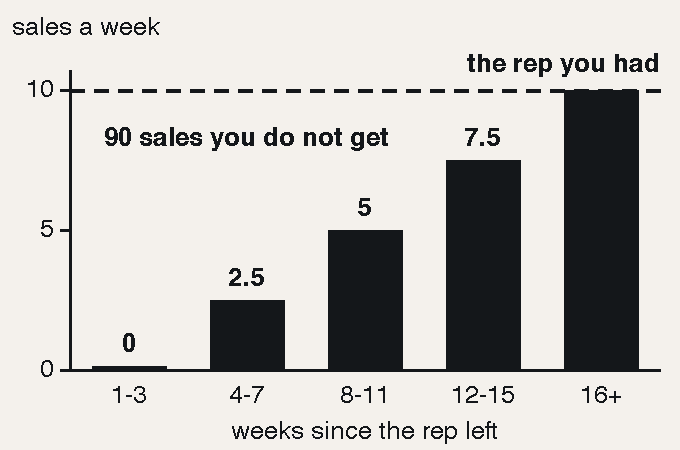
Ninety sales. And that is the good version, the one where the first replacement works out. If they wash out in their eighth week on the job — which is the ordinary case, not the unlucky one, on most teams that have never measured their 30/60/90 survival — the clock restarts. Three more empty weeks, another twelve-week ramp, and the running total lands near 170 sales across about six months.
None of that is a reason to panic and none of it is a number to put in front of the rep. It is a number to put next to the half hour. Whatever you think the conversation is worth, it is competing with ninety.
The number you are watching will not warn you
Most managers say they would notice. What they mean is that they watch the board, and a good rep sliding down the board would show up. It will not, and it is worth being precise about why.
Take the same rep: about 125 conversations in a week, closing about 8 per 100 of them, ten sales in an average week. Run that same rep through a hundred weeks with no change in skill, motivation or intent at all. Ninety-five of those weeks land somewhere between five sales and sixteen. A week of six or worse happens about twelve times in a hundred — and across any eight-week stretch, the chance that at least one week comes in at six or below is closer to two in three.
So a bad week from your best rep tells you nothing, and neither does a bad fortnight. By the time the drop is big enough and long enough to be unambiguous, you are not looking at an early warning. You are looking at somebody who already decided, weeks ago, and has been coasting since. It is the same arithmetic behind how to tell whether a ride-along worked, and it is the single most useful thing to understand about a small sales team.
Their sales number is dice. Their door count is a decision.
Three things that move first, and all three are already in your route log
What follows is judgment, not data. I have not run a study on it and nobody writing about sales retention has run one on door teams either. What I can tell you is what these three have in common, and why that makes them worth more than the sales column: each one is a decision the rep makes, and none of them is an outcome. A sales week is the result of a couple of hundred small events the rep does not control. A door count is the result of what time he decided to go home.
1. Days worked, before doors per day
The first thing that goes is usually a whole day, not part of one. A fourth day where there used to be five, twice in a row, is worth more attention than any single week’s sales figure. It is also the easiest of the three to explain away, because there is always a reason for one of them.
2. Doors per day, over four weeks rather than one
Not a single low day. The four-week line. A rep who has quietly moved from 100 doors a day to 80 has made a decision about how much of himself this job gets, and he made it before he told anybody — often before he could have told you what the decision was.
3. Which streets they take
This one does not show up as a number at all; it shows up in the area column next to their name. Your best rep is usually the one who volunteers for the hard patch, the far patch, the one three people have already given up on. When they stop volunteering and start taking the easy blocks, something has changed about how much of a future they think they have here. How a territory gets split between reps is the currency your good ones actually watch, whether or not anybody has ever said so out loud.
And a fourth that is in no log anywhere: they stop training the new hire. Nobody told them to start and nobody will notice when they stop. If the person who has been picking up every new arrival for four months quietly hands the next one to somebody else, that is a resignation in progress.
The rule, and the three cases where it breaks
Act when two of the three have moved in the same direction across two consecutive weeks. Act by asking, never by managing. One signal is noise; two is a pattern worth a half hour. And the action is a question, because the one thing guaranteed to make a wavering rep leave faster is being managed harder for reasons nobody explained to him.
Three cases where the rule gives you the wrong answer:
- The whole team moved. Before you read anything into one rep’s doors per day, look at the team’s. If everybody is down, you are looking at weather, a season, a change to the product or something you did, and it is upstream of every rep on the board. Sort by street before you sort by person.
- You already know why. A rep taking a class, covering a sick parent, or three weeks into a new baby has a reason, and a reason you already know is not a signal. The rule finds things you do not know about. It fires constantly on things you do.
- The signal is real and the reason is not yours to fix. They are moving out of state. They are going back to school. The rule tells you when to ask; it does not promise the answer is a thing you can change. Finding out eight weeks early that somebody is leaving in March is still worth the half hour — it is the difference between recruiting on your schedule and recruiting on theirs.
The half hour, in the actual words
The conversation goes wrong in the same two ways every time. Either it opens as praise, in which case it is a management technique and the rep knows it inside ten seconds, or it opens as concern, in which case the rep spends the next twenty minutes reassuring you. Neither one gets you an honest answer. Open by naming what you are doing.
When nothing is wrong — and this is the one to run
“I do this with the two people I can least afford to lose, once a quarter, and I do it on a good week on purpose. Nothing is wrong. Four questions. What would make you leave? What part of this would you hand off tomorrow if you could? What are you doing that nobody asked you to do? And what does the next year look like from where you sit?”
Then stop talking. The first answer is usually a polite one. The second answer, to the same question asked again after a silence, is the real one. The answers are almost always small, specific and cheap: a scheduling conflict, a patch they hate, an hour a week of admin, four months of training every new hire with nobody ever mentioning it.
When two of the three signals have moved
Lead with the record, not with reassurance. “Your days are at four the last two weeks and you have been taking Maple and Third instead of the north end. I am not raising it as a performance thing — your close rate is fine and I am not worried about the number. I am asking because those are two changes in the same fortnight and I would rather ask than guess. What has changed?”
Naming the specific observations is what makes this land. “You seem a bit off lately” invites a denial. Two dated facts and a question does not.
When they already have an offer
You are late and the honest move is to say so. “You have got something else. That is fine and I am not going to try to talk you out of it in this conversation. I want two things. Tell me what they are offering that we are not — not to match it, just so I know. And tell me the month you started looking. Because whatever happened that month is the thing I need to fix for the next person.”
A counter-offer at this stage mostly buys weeks, and the rep who stays for one usually leaves within the year having taught everyone on the board that the way to get something here is to go get an offer. The useful thing at this point is not the save. It is the date.
What you can actually offer, when there is no job above them
Most door teams have exactly one seat above rep and it is filled. That is not a reason to have nothing. A good rep is not asking for a title; they are asking whether being good here leads anywhere, and there are four honest answers to that which cost nothing:
- First pick on territory. The most valuable thing you control and the one most managers hand out by accident.
- Training the new hire, named as a role. They are already doing it. Naming it is free; naming it without attaching anything is worse than leaving it alone.
- Running a pod of two. A real span of control at the smallest possible size, which is also how you find out whether they want the other job at all.
- A voice in how routes get assigned. Not a vote. A voice, in the room, before the decision.
And a warning about the obvious one. If what you are considering is a promotion with an override attached, name the hours before you name the override. A promotion on a door team is a transfer of hours away from the promoted rep’s own doors, and the override is smallest exactly when the team is smallest — which is when most people get promoted. Formalizing unpaid work without attaching anything to it leaves your best rep worse off than before you noticed.
Ride with your good ones on the same cadence as everyone else
Not to correct them. Often there is nothing to correct. The ride-along is the visible evidence that somebody is paying attention to their work, and it is the only such evidence most reps ever get. A ride-along that depends on you having a free afternoon is a ride-along that happens for strugglers and never for the top of the board.
There is a second return. Watching your strongest rep work is where you find out what is actually working in your market this month, and that is the material you should be teaching everybody else. A manager who only ever rides with strugglers is coaching from theory.
And when you do praise, be specific and be sparing. “Great job this week” is noise. “You closed the Hartman house after two callbacks nobody else would have made” is being seen. Strong reps can tell the difference, and a rep who decides you are running a technique on them will discount everything else you say afterward.
The two-rep sheet
One page, two reps, seven lines each. Print it, fill it in by hand, keep it where you keep the route log. It takes ten minutes a quarter and it is the whole system.
The two people I can least afford to lose
- Name ______________________ Months in the seat ______
- Days worked, last four weeks ___ ___ ___ ___
- Doors per day, last four weeks ___ ___ ___ ___
- Streets they took last month ______________________
- What they do that nobody assigned ______________________
- What they said would make them leave (their words, dated) ______________________
- The one thing I changed because of it, and the date ______________________
The last line is the one that matters. A stay conversation that changes nothing is worse than no conversation, because now they have told you and watched you do nothing about it.
What to do tomorrow morning
- Write down the two names. Not five. Two.
- Pull their days worked and doors per day for the last four weeks and put the eight numbers on the sheet. Ten minutes.
- Look at the area column next to each name and write down which streets they have been taking.
- Put a half hour on the calendar with each of them this week, as a date, not as an intention.
- Ask the four questions. Write the answers in their words. Say nothing for five seconds after each one.
- Pick one answer and change it inside seven days — and tell them that is why you changed it. The telling is not optional; an unattributed fix teaches them nothing about whether talking to you works.
None of this costs anything. The reason it does not happen is that a rep who is doing well never generates the kind of problem that puts them on your calendar, and management attention flows toward problems by default. From the inside, being left alone does not read as trust. It reads as nobody noticing. So put them on the calendar on purpose, on a good week, before there is anything to fix. It is the same lesson as why a new rep quits, arriving from the other end of the board: the people who go are almost always the ones nobody had a specific conversation with.
Route & Team Tracker
If you want the four-week line rather than a memory of it, the Route & Team Tracker has a Doors / day column on its Weekly Dashboard. Change the week-start date in cell B4 four times, write down that one number for one rep each time, and the four boxes on the sheet fill themselves. It takes about two minutes and it is worth doing before the conversation, not after.