A ride-along changes something when you pick one behavior before you leave the office, count that behavior at the doors, and judge the hour two weeks later on whether the count moved. Not on whether his sales moved. One rep’s sales in one week move a great deal on their own, and that is the real reason so many managers quietly decide ride-alongs don’t do anything.
What follows is the hour in order: what to decide beforehand, what to carry, what to say on the walk between doors, what to say in the three debriefs that go wrong, and what the follow-up number actually is.
Decide the one behavior before you get in the truck
You will see five things. You always do. Go out to watch everything and you come back with five shallow observations, and the rep changes nothing — five pieces of feedback is a performance review wearing a ride-along costume.
So write one sentence before you leave, on paper. Today I am watching what he does in the four seconds after the first no. That sentence is the entire plan for the hour.
Four behaviors are actually visible from six feet away at a real door. They are worth knowing as a list, because the one you pick should come off it rather than out of whatever you happened to be annoyed about that morning.
- The first ten seconds. Energy, distance, and whether he says why he is on this street rather than any other.
- Whether he asks anything at all. A rep who talks for ninety seconds without a question is presenting, not selling, and you can hear it from the sidewalk.
- What he does with the first no. Specifically: does he work out which kind of no it is before he answers it, or does he fire the same rebuttal at all of them?
- How he leaves a door he has lost. This is the one nobody watches, and it decides what that street is like next month.
Pick the earliest one where you have seen a problem. Fixing the opening changes every door after it. Fixing the exit only changes the doors that got that far.
Where that rule breaks
If his doors per day is low, door behavior is not this week’s problem and a ride-along is the wrong tool. You will spend an hour polishing the eleven doors he knocks when the thing he needs is to knock thirty. Look at the route, the start time and what he does between streets first.
And there is one case where you should go out with no behavior in mind at all: a rep in his first week. You are not there to correct anything. You are there so that day four has a person in it.
What you carry
One sheet, three columns, one row per door. Print about twenty-five rows and take a pen you can write with standing up.
The behavior I am watching today: ________________
| Door | Y / N | The words he used |
|---|---|---|
| 1 | ||
| 2 | ||
| 3 | ||
| 4 | ||
| 5 |
Doors: ______ Conversations: ______ It happened on: ______ of them
The third column is the one managers skip, and it is the one that does the work. The count is what you compare in two weeks. The words are what make the debrief a conversation instead of an argument.
“You said okay, no worries, have a good one, and you were already turning” is a fact he was standing next to. “You gave up too fast” is an opinion, and a rep will defend himself against an opinion for ten minutes and remember nothing else about the hour.
Do not take a ten-point evaluation form. They are everywhere and they are free and they produce ten shallow scores and no change. One row per door beats them because it is a count of a thing rather than a grade of a person.
Five rules for the hour
1. Say nothing for the first three or four doors
The first door with you standing there is not his normal door. He is performing, he is nervous, and whatever he does is partly a reaction to being watched. Coach that one and you are coaching your own presence.
Say it out loud before the first knock so he isn’t waiting for a verdict: “I’m going to be quiet for the first few. Work like I’m not here.” Then actually be quiet, including with your face. The manager who says nothing while raising his eyebrows at every door has not been quiet.
2. One thing. Not five.
One thing, worked on for a week, changes. Five things overwhelm, feel like a verdict on the person rather than a note on a habit, and reliably produce nothing. If you cannot choose, choose the one that comes earliest in the conversation.
3. Coach on the walk, not at the end of the day
Thirty seconds on the way to the next house, while the conversation is still live in both your heads. One thing that worked, one thing to change, and he gets to test it four minutes later.
End-of-day feedback is a lecture about a conversation neither of you now remembers precisely, delivered at the hour when he is tired and wants to go home.
4. Demonstrate it — don’t describe it
After you have named the one thing, take the next door yourself and do it. Telling produces agreement — almost every rep will nod at almost any feedback. Showing produces change, because now he has seen the thing exist instead of hearing it described, and he can copy something concrete instead of interpreting an instruction.
It has a second effect worth having. It puts you back at a door in front of your team, which does more for your standing as a coach than anything you say in a meeting.
5. Never take over a door he is winning
This is the one that does lasting damage. A rep is deep in a good conversation, it is nearly there, and the manager steps in to land it. It reads as you can’t do this. It takes the sale off his number. And reps remember it for a year — you will hear it repeated back to you months later, in a conversation about something else entirely.
There is one exception, and even then it is asked rather than taken. If the door is being lost badly and the customer is confused, say “do you want me to take this one?” — and if he says no, you don’t. Afterward, debrief it out loud so it does not sit there as a rescue.
The debrief, in three registers
The debrief is thirty seconds on a sidewalk, not a meeting. Which thirty seconds depends on which rep is standing next to you, and this is where most ride-alongs are actually lost.
He did it, or mostly did
Lead with the count, not with praise. “Twenty-two doors. You asked the question on nine of them, and on seven of those nine you got a second sentence out of the person. On the thirteen where you skipped it you were at the next house inside a minute.” Then: “Same thing next week. That’s all I’ve got.”
A number he watched you write down is not something he can discount as management noise, and it is not something he has to decide whether to believe.
He gets defensive
What comes back is one of three sentences: that street was dead, you being there changed it, or that’s just not how I talk. All three are partly true, which is why arguing with them goes badly.
Agree with the true part first, out loud and specifically, then go back to the sheet. “You’re right that they knew something was up — I’m standing there in a polo holding a clipboard. Doors nine through twenty-two, though, you’d stopped noticing me. Nine of those fourteen, you didn’t ask.”
What you must not do is win. You are not trying to prove the observation was correct. You are trying to get the same thing counted again in two weeks, and a rep who lost an argument on a sidewalk will spend the next ride-along managing you instead of the door.
He had a bad hour and he knows it
Some hours are just bad. Nobody home, one person rude early, no rhythm after that. He knows. Coaching into that is how a rep decides the ride-along was a performance review after all.
Say the true thing, name the one behavior, and then stop talking. “That was a rough hour. I’ve had them. One thing I saw, and then I’ll leave you alone.” Then the behavior, in a sentence. Then: “Try it Monday. I’ll be back out with you on the eighteenth.”
Then leave. The urge to add a second thing because you feel bad for him is the same mistake as saying five things; it just wears a kinder face.
When the hour didn’t count
Some hours cannot be read, and reading them anyway is worse than not going. Four cases, and the response to all four is the same — say so plainly and rebook.
- Fewer than eight or ten conversations. You watched him knock. You did not watch him talk. Coaching an opening off three conversations is coaching off nothing.
- The behavior never came up. If you came to watch the first no and four doors opened, you have four observations. Don’t build a week of homework on four.
- He picked the street. Don’t let him. Not because he would cheat, but because he will pick the one he knows, and the one he knows is where his habits look best.
- Weather, or one genuinely hostile customer early. Both change every door after them. Note it on the sheet and discount the hour.
Saying “that hour told me nothing, I’ll come back Thursday” costs you an hour. Coaching from an hour that told you nothing costs the rep a week working on the wrong thing — and costs you the next ride-along, because he will remember that the last one was noise.
How to tell whether it worked
Here is the trap, and nearly every manager falls into it once. You ride along Tuesday. You name one thing. The rep works on it. The following Monday you look at his sales, they are flat or down, and you conclude the hour didn’t do anything. The next ride-along slips a week, then a month, then off the calendar.
The trouble is that one rep’s sales in one week move a lot on their own. Take a rep who gets about ninety conversations in a week and closes about one in eleven of them. That is a little over eight sales in an average week. Now run that same rep, with no change in skill at all, through a hundred weeks.
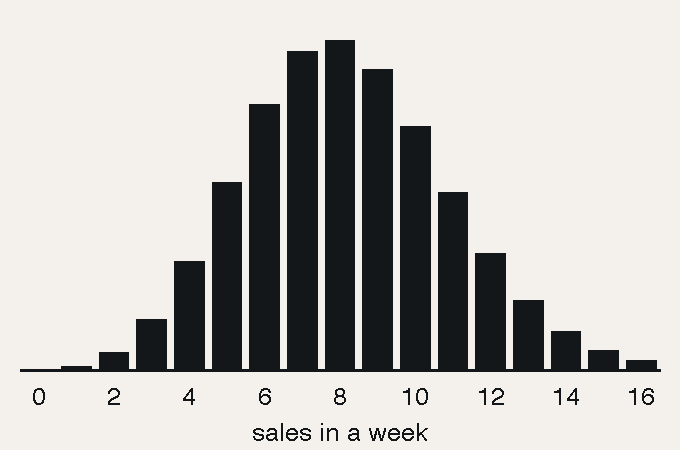
He lands somewhere between four and thirteen sales in ninety-four of those hundred weeks. Six one week and eleven the next is not improvement. Eleven one week and six the next is not a slump. Both are the same unchanged rep having two ordinary weeks.
None of that is a survey finding and there is nothing in it to take on trust. It is simply what ninety separate one-in-eleven chances produce, and you can rebuild the whole picture with a column of random numbers in a spreadsheet in about five minutes.
So next Monday’s sales number cannot answer the question you are asking it. The behavior count can, because you are not sampling a week — you are sampling twenty-odd doors, and at each one the thing either happened or it didn’t.
A week of sales is a coin. A behavior counted at twenty-two doors is a measurement.
Concretely: three out of twenty-two on the first ride, fourteen out of twenty-five on the second. Chance does not do that. That is a rep who changed what he does at a door, and it is visible two weeks after the hour rather than two months after it.
Whether the change turns into sales is a separate and slower question. You will see the answer in a month or two of totals, not in next Monday’s number — and by then you will have run two more ride-alongs, which is the point.
How often
Weekly for a rep’s first month, then every two to three weeks. Even one hour counts — the value is concentrated at the front and drops off sharply, so four one-hour rides beat one long day with the same person.
Put them on the calendar as dates. A ride-along that depends on you having a free afternoon is a ride-along that happens for your struggling reps and never for your good ones — and your good ones are the ones who leave because nobody was paying attention.
What to do tomorrow morning
- Pick one rep. Not your worst — the one you last had a specific thought about.
- Write the sentence. One behavior, on paper, before you leave.
- Print the sheet. Three columns, twenty-five rows.
- One hour. Say nothing for the first four doors.
- Say one thing on the walk to the fifth. Take the sixth door yourself and do it.
- Before you get back in the truck, put the second hour on the calendar for thirteen days out. Not “in a couple of weeks.” A date, with him watching you type it.
Four things to watch, one thing to say, one number to count. That is a ride-along.
90-Day D2D Recruiting & Retention Playbook
Where the ride-along sits in the rest of the coaching year — how often to book it once a new rep is past the first month, and the weekly one-on-one that fills the weeks between — is Part 6 of the 90-Day D2D Recruiting & Retention Playbook. The thing most managers get wrong about it isn’t the hour. It’s that they run one, look at the scoreboard the following Monday, see nothing, and never book the second.