Tell a new rep six things on their first day, out loud, before they knock: what makes money come back off a sale, how long the window stays open, whether it comes off a check or a draw balance, roughly how many weeks after the sale it lands, what the line on the pay statement will be called, and one sentence — this will happen to you, and it will not mean you did anything wrong. Five minutes. Do it before the first sale, because said afterward it sounds like an excuse. A deduction nobody warned them about does not read as a policy. It reads as theft.
The mechanics vary by industry and by company — a cancellation before install, a customer who churns inside a window, a percentage held against future cancellations. The management problem is identical everywhere. Money that was in a rep’s hand leaves it, weeks later, for a reason they did not see coming, and how they take that is decided almost entirely by what you said before it happened.
This is management guidance, not legal advice. What can be deducted, when, and with what disclosure varies by state and by classification. Confirm your own arrangement with a qualified professional.
The first three days belong to the customer
Before you decide what any cancellation says about a rep, know which part of the window is not yours. The FTC’s Cooling-Off Rule requires that a door-to-door contract carry, in bold face type of at least ten points, a statement in substantially this form:
“You, the buyer, may cancel this transaction at any time prior to midnight of the third business day after the date of this transaction. See the attached notice of cancellation form for an explanation of this right.”
16 CFR § 429.1(a)
The same rule defines the sales it covers by price — $25 or more at the buyer’s residence, $130 or more at other locations such as a hotel room or a fairground (§ 429.0(a)) — requires the seller to tell the buyer orally about the right to cancel at signing (§ 429.1(e)), requires a completed Notice of Cancellation in duplicate (§ 429.1(b)), forbids putting any waiver of the right into the contract (§ 429.1(d)), and gives the seller ten business days to refund once a valid cancellation arrives (§ 429.1(g)). Whether and how it applies to what you sell depends on your product and your paperwork; the permit-and-paperwork side of this is covered in full in permits, no-soliciting signs, and the rules nobody tells a new rep.
One thing follows for a manager either way, and it changes how you coach: you cannot coach a rep out of the first three days. That part of the window is a right the customer holds regardless of how good the rep was. Which means the earliest slice of every chargeback number you look at is, by construction, not a performance signal — and a manager who treats it as one is teaching the team to fear the customer’s second thoughts, which makes reps vaguer at the close, which produces more cancellations rather than fewer.
One sale, two clocks
Almost every argument about a chargeback is really an argument about timing. The commission arrives at a single moment. The exposure is a band, and most of the band sits after payday.
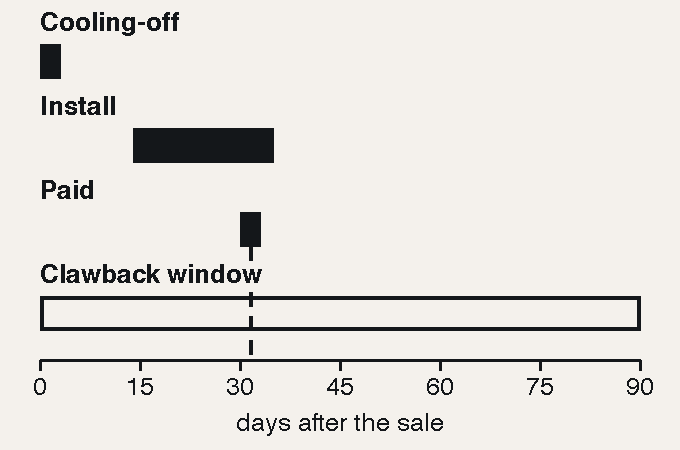
Draw your own and two things become obvious. The first is how much of the window falls after the rep has spent the money. The second is how old the sale is by the time the deduction appears — on a schedule like the one above, a rep looking at a statement in the middle of the following month is being asked to remember a conversation from six weeks ago, at a door they knocked once, among a hundred others. That is not a memory problem. It is a records problem, and it is yours.
The six lines to fill in before anyone knocks
Write the answers down before you say them out loud. A manager who improvises line three discovers in front of the person it applies to that he does not actually know the answer.
The day-one chargeback sheet
1. What makes money come back here. Name the events, not the category. Fails when “cancellation” is used for three different things — a customer who backs out in three days, an install that never happens, and an account that churns in month four are not the same event and may not carry the same consequence.
2. How long the window is, counted from what. Fails when nobody says whether the clock starts at the signature, the install, or the customer’s first payment. Reps assume the signature. It is usually not the signature.
3. Where it comes from. This check, the next one, or a draw balance. Fails when the rep assumes a smaller check and it is actually a larger negative balance carried forward — which is invisible until the month they expected to be out of the hole and are not.
4. How long after the cancellation it shows up. Fails when the answer is “the next cycle” and the real answer is two cycles, because the cancellation has to reach your payer before it reaches your statement.
5. What the line will be called, word for word. Read them the actual string. Fails when the string is “adjustment.” A rep cannot check an adjustment, so a rep learns not to check anything.
6. The sentence. “This will happen to you at some point, and it will not mean you did anything wrong.” Fails when it is skipped as obvious. It is not obvious to someone in their first month. Without it, the first chargeback arrives as evidence that they are bad at the job, on top of arriving as lost money.
Six answers, one page, handed over rather than recited. Then it survives you being on the phone the week their first one lands.
Is this rep’s number a problem, or is it a coin?
Here is the situation that costs good reps. Someone sold twelve last month and three of them came back. Twenty-five per hundred, against a team sitting at twelve per hundred. Double the team. It looks like an obvious coaching conversation, and it is nearly always the wrong one.
Suppose that rep is exactly average — their true rate is the team’s twelve per hundred, no better and no worse. Across twelve sales, three or more of them coming back happens about seventeen times in a hundred months. Roughly one month in six, from nothing but which customers happened to be theirs.
Now run six reps. If every one of them is exactly average and each sells about a dozen, the chance that at least one of them shows three or more cancellations is about sixty-seven in a hundred. Two months in three, somebody on your board looks like a problem and is not one. If you hold a conversation every time that happens, you will hold it eight times a year with people who did nothing, and the reps will notice that the criterion is a bad month rather than bad work.
How many sales it takes before the number settles down:
| Sales | Cancellations | Per 100 sales |
|---|---|---|
| 12 | 0 to 4 | 0 to 33 |
| 25 | 0 to 6 | 0 to 24 |
| 50 | 2 to 11 | 4 to 22 |
| 100 | 6 to 19 | 6 to 19 |
| 200 | 15 to 33 | 7.5 to 16.5 |
| 400 | 36 to 61 | 9 to 15 |
Read the first row again. At a dozen sales, the honest range for an average rep runs from none to a third of everything they sold. There is no reading of a month like that. At a hundred sales the range has narrowed to six-to-nineteen per hundred, and a rep sitting at twenty-five is genuinely outside it — that number is worth acting on. This is the same argument that governs a conversation rate at forty doors, made about a different quantity: count the sentence at twenty doors and judge the rate at four hundred.
A cancellation rate over a dozen sales is a coin. Over a hundred, it is a fact.
The rule, and the three places it breaks
Do not act on a rep’s cancellation rate until about a hundred of their sales are behind it. Below that, act on what you heard at a door, not on what came back. That is the rule, and it holds most of the time. Three cases where it does not:
It is a cluster, not a rate
Sort the rep’s cancellations by street before you sort them by rep. If all four came out of one building or one list, the rate is telling you about the list. That is visible in an afternoon and does not need a hundred sales — and if it is a building, the person to talk to is the property manager, not the rep.
It moved for everybody at once
If cancellations rose across the whole team in the same two weeks, the cause is upstream of every rep on the board — install capacity, a price change, a scheduling backlog, a service failure in one region. A team-wide move is never a rep problem, and coaching individuals through it is how you lose the two who were doing fine.
You heard the cause with your own ears
The rule governs when a number means something. It never obliges you to ignore something you witnessed. If you stood next to a rep who promised an install date nobody can hold, you do not need a hundred sales to know what to say — and the place to find that out is a scheduled hour at doors, not a spreadsheet. That is what a ride-along is actually for.
A rep has to be able to reconstruct their own pay
If they cannot, they will assume they are being shorted — and in this industry they will be right often enough that you cannot dismiss the suspicion. Four fields make a chargeback line checkable: which sale it relates to, what happened to that sale, when it happened, and which pay period it is being taken out of. Drop any one of them and the line becomes an assertion.
If your payer’s statements do not carry all four, keep your own log. It is four columns and about ten minutes a week, and the alternative is arguing from memory with somebody who is better at remembering their own sales than you are. Note that this log is separate from a route sheet — a route log records doors, conversations and sales, not what came back off them later, so do not expect one file to do both jobs.
Three conversations, in the actual words
Day one, before the first door
“I’m going to walk one sale all the way through, including the part where it goes wrong. Here’s what it pays and when. Here’s the window, and here’s what starts the clock. If it comes back inside that window, here is exactly where you’ll see it and here is what the line says. It will look like this.” Then, before you move on: “This will happen to you at some point, and it will not mean you did anything wrong. I’d rather you hear that now than the first time you see it.”
The first one lands
Lead with the record, not with reassurance. “This is the Miller sale from the ninth. They canceled on the nineteenth, before install. That’s the line you’re looking at, and that’s why it’s on this check instead of the last one.” Then, and only then: “Nothing about this one was yours. Most of them aren’t. I’m not looking at any single one of these, and neither should you.” A rep who can see which sale it was stops being angry considerably faster than one who is being told not to worry.
The rate really is high
When there are enough sales behind it, say the number and say what you are not saying. “Over your last hundred and ten sales you’re at twenty-four per hundred coming back. The team is at twelve. That’s far enough outside the normal wobble that I don’t think it’s luck any more, and it’s costing you money, not me. I don’t know yet what’s causing it. I want to spend Thursday morning at doors with you and find out.” No verdict, one number, a specific next step, and a reason it matters to them.
Every chargeback structure is an instruction
Whether you meant it that way or not, reps read the policy as a description of what you want.
A long clawback window teaches reps to sell only to people who look permanent — which sounds like quality and often means avoiding renters, young households and anyone in transition, in ways that are worth examining carefully. A percentage held off the top teaches nothing in particular and is experienced as a pay cut with a story attached. A short window tied to install teaches reps to make sure the install actually happens, which is usually the behavior you wanted in the first place. If your reps are quietly avoiding a whole category of customer, look at the clawback terms before you look at the reps — and while you are there, look at whether the underlying plan is straight commission, a draw or a base, because a clawback lands very differently on each.
The upstream fix is one sentence at the close
Most preventable cancellations are created at the door, by a promise slightly larger than the product. Not lies — enthusiasm, and a rep who did not want to introduce friction into a conversation that was going well.
The countermeasure is cheap and it is a procedure, not an attitude. Pick the single limitation your product actually gets canceled over — what it does not do, what the install really involves, what the bill looks like in month four. Write it as one sentence. Have every rep say that same sentence in the same place: after the yes, before the paperwork. Then it is not a judgment call made by a nervous twenty-two-year-old at the exact moment they least want to make it.
Three ways it goes wrong. It grows into a paragraph, and a paragraph at the close is a second sales presentation the customer did not ask for. It gets said apologetically, which tells the customer there is something to apologize for. Or the limitation chosen is one nobody actually cancels over, in which case you have added friction and removed nothing — so pick it by reading your own cancellation reasons, not by guessing.
It costs a small number of sales and removes a larger number of cancellations. It also removes the version of this that ends with somebody good leaving in week three because their pay moved underneath them without warning — and when a new rep goes quiet, it is nearly always because something specific happened on a specific day.
What to do tomorrow morning
- Write down the six answers. Fifteen minutes, on one page. If you cannot answer number three or number four without checking, that is the finding.
- Draw your own version of the timeline — sale, window, install, payday, and the day a deduction actually appears. Look at how much of it sits to the right of payday.
- Take the rep you have been quietly worried about and count how many of their sales are behind the number. Under a hundred, close the spreadsheet.
- Open one rep’s most recent statement and try to reconstruct it yourself from your own records. Whatever you cannot reconstruct, they cannot either.
- Say the sentence to everyone who has not heard it, including the reps who are well past their first sale. It works late; it just works better early.
- Pick the one honest limitation for your product, write it as a sentence, and give it to the team at the next morning meeting with the place it goes.
Route & Team Tracker
Then, before you put any clawback arrangement in front of a rep, run it. The Comp Calculator tab of the Route & Team Tracker has a chargeback / fee rate input; enter your real one, note the take-home it returns at your rep’s actual volume, then set the rate to zero and run it again. The gap between the two numbers is what the rep is going to feel every month. It is a much better thing to see before you write the plan than after they do.
Sources: 16 CFR § 429.0 and 16 CFR § 429.1, the FTC Cooling-Off Rule, quoted verbatim and checked 7 September 2026. Rules change and state law adds to them — verify your own before relying on any of this.