The first ten seconds has one job, and it is not selling. It is getting to the eleventh second. Four clauses do that, in this order: who you are and why you are on this street, how long this will take, what it is about in words they would use, and one question they can answer without thinking. All four, under ten seconds. Everything else a rep gets coached on happens after the door stays open, and none of it matters if the door does not.
The rest of this is how to tell whether the opening is your problem at all, how to write your own four lines, and how many doors it takes before the conversation rate can honestly tell you the change worked.
First, is the opening even the problem?
Reps who are struggling almost always want to work on their pitch. Nine times out of ten the pitch is fine and they are never getting to use it. One number separates those two problems and most teams do not track it: conversations divided by doors, the conversation rate.
Ninety doors and eight conversations is an opening problem. Ninety doors and thirty conversations is an opening that works and something failing later. Those need opposite fixes, and coaching the wrong one is how a fixable rep gets cut.
That diagnosis is safe to make on a single day’s numbers, and it is worth seeing why, because the next one is not. Take a rep whose real conversation rate is 25 conversations per 100 doors — not a benchmark, just a number to run the arithmetic on. Across ninety doors, chance alone lands him somewhere between fifteen and thirty-one conversations in about ninety-six mornings out of a hundred. Eight is not that rep having a bad morning. It is a different rate. The gap between eight and thirty is far too wide for luck to have made it.
What the conversation rate cannot tell you
Deciding whether the coaching worked is a different question, and it is where most opening coaching quietly falls apart. Same rep, same real rate of 25 per 100. Here is the range chance alone puts him in, over four different numbers of doors.
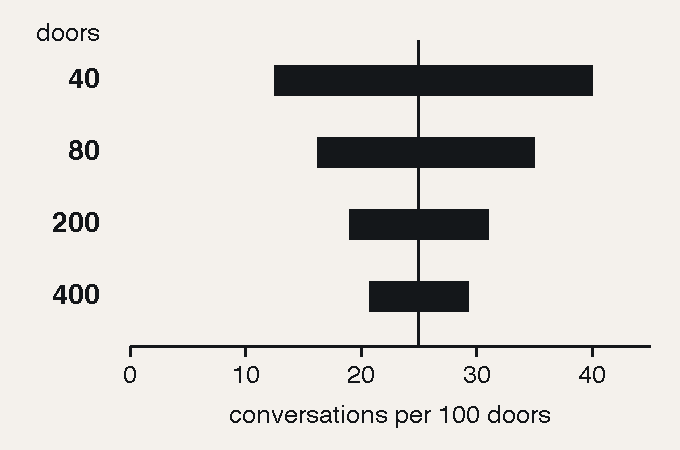
One morning of forty doors puts him anywhere between five and sixteen conversations. In the units the log keeps, that is thirteen to forty conversations per 100 doors, from a rep who has changed nothing. Two of those mornings back to back differ from each other by four or more conversations better than a third of the time — again, with nothing changed. So a rep who has seven conversations on Monday and eleven on Tuesday has shown you nothing, and a manager who calls the fix successful on Tuesday afternoon is reading weather.
It takes about four hundred doors, which is a full week for most reps, before the range tightens to twenty-one to twenty-nine per 100. That is roughly the point at which a real change in the opening starts to be visible in the rate at all, and only if the change was a large one.
Count the sentence at twenty doors. Judge the rate at four hundred.
What you can measure in a single morning is the behavior instead of the outcome. Whether the rep said the clause about why he is on this street is a yes or a no at every door, so twenty doors gives you twenty clean answers rather than one noisy one. That is the same reason a ride-along should count a behavior rather than a day of sales. Count the sentence this week. Read the rate next week.
The three questions behind every opening
The person at the door is asking three things before they have consciously formed any of them:
- Is this safe?
- How long is this going to take?
- Is this about me, or about you?
Almost every failed opening fails one of those three, and usually the second. They are not rejecting your product. They cannot be — they do not know what it is yet. They are declining an interaction of unknown length with a stranger who has given them no way to estimate the cost. The four lines below are those three questions answered before anyone asks them out loud.
Write your four lines
Not a script. The words have to be yours or they will not survive contact with a real porch. But the four slots are fixed, and each one has a test you can apply to your own sentence before you ever say it to a stranger. Write them on paper.
The four-line worksheet
Line 1 — who you are and why this street. One clause, both halves. The test: could a neighbor overhear it and know why you are on the block? A line that only says your company name fails, because it answers a question nobody asked. The unspoken one is “why me?”
Line 2 — the bound. A number, said out loud. The test: is it actually a number, and would you honor it at a door that is going badly? A bound you break is worse than no bound at all. The reps who blow past their own stated thirty seconds are why the next rep on that street gets the door shut on him.
Line 3 — what it is about, in their words. The test: does it name something at their house — the meter, the roof, the yard, the bill — rather than something in your catalog? If the sentence needs your product’s name to make sense, rewrite it.
Line 4 — the question. Factual, not evaluative. “Are you the one who handles the bill here?” beats “Are you happy with your service?” The test: can they answer it without forming an opinion? An evaluative question is work, and at second eight, work is the thing they are trying to avoid.
Then time it. Read all four out loud at the speed you would really use, with a stopwatch. Over ten seconds, cut line 3 first — it is the one that grows every week. Under about six seconds and you have probably dropped a line without noticing; go back and find which.
The same four lines at three different doors
The door opens on a chain
Line 2 moves to the front and gets shorter. The chain is a safety answer, so answer safety first: give the bound, then line 1, and do not step forward while you are talking. Most reps read a chain as hostility and speed up. It is not hostility, it is question one, and it is the easiest of the three to satisfy.
“Not interested” before you finish line 1
It cannot be an objection. They have not heard anything to be uninterested in. It is a reflex aimed at the situation, and treating it as an objection — arguing with it, handling it, deploying a rebuttal — is how reps burn their best material on people who have not received any information yet. Finish the sentence you were in the middle of, shorter, and let them go if it comes back. If the same reflex fires twice, it is real, and how you leave is worth more than the extra thirty seconds you were going to spend arguing.
A speaker instead of a face
Lines 1 and 2 have to carry the whole thing, because the two things doing most of the work at a normal door — where you are standing and what your face is doing — do not transmit. Say the street name out loud; it is the only piece of “why me” that survives the trip. What a camera changes and what it does not is its own subject, and the short version is that it eats your body language and leaves your words.
Four things that reliably hurt
Too much energy. High enthusiasm at a stranger’s door reads as pressure, and pressure reads as a con. Reps get coached to bring energy and then cannot work out why people close the door on them. Lower it. You are not on a stage.
Standing too close, or square-on. Take a step back before they open. Stand slightly off to the side rather than filling the doorway. Nobody is ever going to tell you that this is why they relaxed, and it costs you nothing to do it anyway.
Opening with a question they have to think about. “How’s your internet been lately?” sounds conversational and is actually work. See the test on line 4.
Leaving line 1 half-finished. Saying who you are and skipping why you are on this street is the single most common way an opening fails, and it is the one a rep cannot hear himself doing. It is also the easiest to count from six feet away, which is why it is the clause worth marking on a ride-along.
When a low conversation rate is not an opening problem
Five things drag the rate down that no amount of opening coaching will fix. Rule them out before you decide a rep is weak at the opening and spend a week on his first sentence.
- The hour. The same rep, the same words, on the same street at the wrong time of day produces an opening-problem-shaped number. Finding your actual hour comes first.
- The building. Doors inside a managed complex behave nothing like doors on a street, and the number that matters there is whether you got past the office at all rather than what you said at unit 12. That is a different job.
- Cameras. A block where half the doors are answered through a speaker will show a lower rate for reasons that have nothing to do with the rep’s sentence, and everything to do with whether your team counts a camera answer as a conversation.
- How doors are being counted. If one rep logs an empty house as a door and another does not, their conversation rates are not comparable — and neither is one rep’s week against his own last week if he quietly changed his mind halfway through. Settle the definition first; a rate is only as good as its denominator.
- A conversation rate that is fine and no sales. Then the opening is doing its job and the problem is downstream, in what you are hearing after it. Coaching the opening here makes a working thing worse.
The ninety-second drill, and three ways it goes wrong
At the morning meeting, one rep at a time. He says his four lines once, at the volume he would use at a door, to the room. You run a stopwatch. When he stops you say one thing: which line was missing, or which one ran long. Nobody answers him, nobody plays the homeowner, and it is over in about ninety seconds a rep.
Three ways it stops working, all of which I have watched happen:
Somebody starts playing a hostile homeowner. It is the most fun version and the least useful one, because it quietly measures who is good at improvising in front of colleagues. The failure you are hunting is a missing clause, and a missing clause is perfectly audible in a quiet room with nobody interrupting.
It turns into a performance. Reps polish for the room and then say something else entirely at door one. The drill is not the measurement. The measurement is hearing the same four lines at a real door inside two days, which means the drill only earns its ninety seconds if somebody actually goes out.
You coach all four lines at once. Take the earliest one that is broken and leave the rest alone. The lines are sequential, so a bad line 1 means lines 2 through 4 were never heard by anybody — you would be rewriting a sentence that never reached a human being.
What to do tomorrow morning
- Pull last week’s doors and conversations for each rep out of the log. Write both raw numbers down, not the rate — you want to see how many doors each number is standing on.
- Anyone whose conversations are far below the rest of the team on a similar number of doors has an opening problem. Anyone whose conversations look normal and whose sales do not, does not. Do not use one morning for this.
- Have that rep write his four lines this morning, in his own words, on paper, before he leaves.
- Time him reading them out loud. Cut until it is under ten seconds. Cut line 3 first.
- Go stand at twenty of his doors and mark one column only: did line 1 come out whole, yes or no. Not how it felt. One mark per door.
- Put the check on the calendar for the end of next week, as a date, when he has four hundred doors behind the change and the rate is finally worth reading.
Objection-Handling Script Pack
The reflexes that arrive before the conversation rather than during it — “not interested,” “I already have that,” “I don’t have time” — are not objections, and spending an objection response on one wastes it. The Objection-Handling Script Pack has a section on those three stalls and the words for each.