Divide for it, then time it. Doors per day needed = the sales per day you need ÷ that rep’s own sales per 100 doors × 100. A rep who needs 1.2 sales a day and makes 1.47 sales per 100 doors needs 82 doors a day. Then check the 82 against the clock, because some targets cannot be reached by knocking harder, and the division alone will not tell you which ones.
That is a different kind of answer from the ones you will find published. SPOTIO’s door-to-door guide says top reps “aim to knock 50–70 doors per day.” The worked example in portatour’s D2D sales guide has each rep knock “a minimum of 200 doors per day.” Both read on 13 September 2026. Neither number is wrong for somebody. But a doors-per-day figure is the output of a division, and when you borrow the output you borrow somebody else’s product, neighborhoods and definition of a door along with it.
The division, run on three reps
Three reps, one target: six sales a week each over a five-day week, which is 1.2 sales per day. The reps and their counts are invented for the example. The arithmetic is not, and every figure below can be rebuilt from the four counts at the top of each column.
| Last three weeks | Alex | Jordan | Sam |
|---|---|---|---|
| Days worked | 15 | 15 | 15 |
| Doors | 1,275 | 1,020 | 900 |
| Conversations | 255 | 204 | 108 |
| Sales | 21 | 15 | 6 |
| Doors per day | 85 | 68 | 60 |
| Sales per day | 1.4 | 1.0 | 0.4 |
| Conversation rate, per 100 doors | 20.0 | 20.0 | 12.0 |
| Close rate, per 100 conversations | 8.24 | 7.35 | 5.56 |
| Sales per 100 doors | 1.65 | 1.47 | 0.67 |
| Doors per day needed for 1.2 sales | 73 | 82 | 180 |
Two lines of that table are worth doing by hand once, so you trust the rest.
Sales per 100 doors is the two rates multiplied. Jordan: a conversation rate of 20 per 100 doors times a close rate of 7.35 per 100 conversations, divided by 100, is 1.47 sales per 100 doors. That is also just 15 sales ÷ 1,020 doors × 100. Both routes land on 1.47, which is the check that you divided the right things by the right things.
Doors needed skips the rounding if you run it from the raw counts. Target sales per day × doors ÷ sales. Alex: 1.2 × 1,275 ÷ 21 = 72.9, so 73. Jordan: 1.2 × 1,020 ÷ 15 = 81.6, so 82. Sam: 1.2 × 900 ÷ 6 = 180.
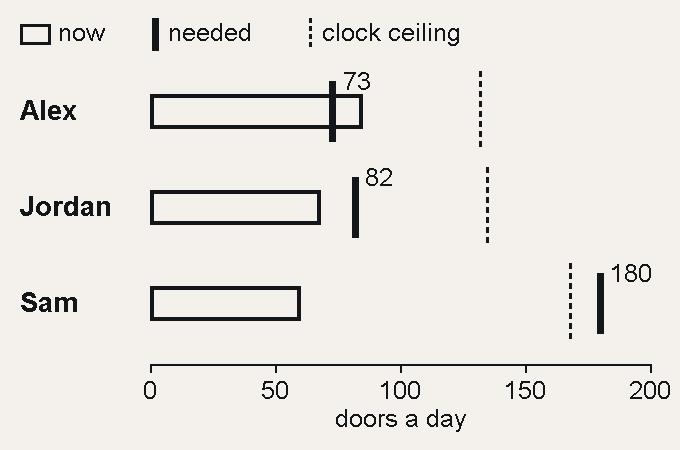
So Alex needs 73 and knocks 85. Jordan needs 82 and knocks 68. Sam needs 180 and knocks 60. Tell the whole team to get their doors up and you have given the right instruction to one person out of three.
A doors-per-day target is the answer to a division. If you didn’t do the division, you are holding somebody else’s answer.
Then check it against the clock
A doors-per-day number is a claim about time. Every door costs the walk to it and the wait at it. Some cost a conversation. A few cost a sale. So before you hold anyone to 180, find out how many doors fit in the day at all. Go out for an evening with one rep and a stopwatch, and write down four numbers:
- Walk. Seconds from leaving one door to knocking the next.
- Wait. Seconds from the knock to either an answer or giving up.
- Conversation. Seconds an average conversation lasts.
- Sale. The extra seconds a sale adds on top of that: the paperwork, the spouse who has to come to the door, the walk-through.
Say the evening comes back at 45 seconds walking, 30 waiting, 3 minutes a conversation and 25 extra minutes a sale. Those are this example’s inputs, not a finding. Yours will be different by product and by neighborhood, which is the whole reason to time them rather than borrow them.
Seconds per door = walk + wait + (conversation rate ÷ 100 × conversation seconds) + (sales per 100 doors ÷ 100 × sale seconds)
Clock ceiling = door hours × 3,600 ÷ seconds per door
Door hours are hours standing in front of doors. Not the drive out, not the morning huddle, not the gas station. This example uses five.
Jordan: 45 + 30 + (20 ÷ 100 × 180) + (1.47 ÷ 100 × 1,500) = 45 + 30 + 36 + 22.1 = 133.1 seconds a door. Five door hours is 18,000 seconds, and 18,000 ÷ 133.1 = 135 doors. That is Jordan’s ceiling.
Alex: 45 + 30 + 36 + 24.7 = 135.7 seconds, a ceiling of 132. Sam: 45 + 30 + 21.6 + 10.0 = 106.6 seconds, a ceiling of 168. Sam has the highest ceiling on the team for the worst possible reason: people close the door on him faster, so his doors are cheap.
Ceilings are rounded down, for the same reason needed doors are rounded up. And 168 is still less than 180.
The rule: every rep is in one of three places
- Needed at or below what they knock now? On pace. Leave volume alone. Alex needs 73 and knocks 85; doors are not the conversation to have with him this week.
- Needed above what they knock, but under the ceiling? A volume problem, and a fixable one. Jordan is 14 doors short, and at 133.1 seconds a door that is about 31 minutes more in front of doors. That is a start time or a long lunch, not a character flaw. Look at the route and the start time before you look at the rep.
- Needed above the ceiling? No amount of knocking gets there. The fix is one of the two rates, the territory, or the target itself. Telling Sam to knock more is telling him to do something the day does not have room for, and he will either leave or start logging doors he did not knock.
Sam is the case worth working through, because the rule says which rate to go after first. His conversation rate is 12 per 100 doors against 20 for the other two, over 900 doors. That is enough doors for the gap to be real rather than a bad couple of weeks. His close rate rests on six sales, which is not enough to say anything about.
So run the division as if his opening came up to 20 and his close rate stayed exactly where it is. Over the same 900 doors, 20 per 100 is 180 conversations, and at 6 sales per 108 conversations that is 10 sales, or 1.11 per 100 doors. Needed: 1.2 × 900 ÷ 10 = 108 doors. New ceiling: 45 + 30 + 36 + 16.7 = 127.7 seconds a door, and 18,000 ÷ 127.7 = 140. Sam moves from the third place to the second. That is the coaching order, written down before anyone has a conversation with him: the opening first, because it is the rate that brings his target back inside the day.
Where this goes wrong
1. Six sales is not a close rate
The needed number inherits all the noise of the smallest count inside it, and that count is almost always sales. Give Sam one more sale in the same three weeks and his close rate goes from 5.56 to 6.48 per 100 conversations, and his needed doors fall from 180 to 155. One sale moved the target by 25 doors a day.
So run it on at least three weeks of logs, and on a rep in their first month treat the result as a sketch. That floor is my judgment, not a finding. The reasoning behind it is in the only four numbers worth reading: flag an opening on the week, flag a closer on the month.
2. The extra doors are not the same doors
The division assumes Jordan’s 82nd door goes the way his 30th did. It may not. The extra doors come from somewhere: earlier in the afternoon when fewer people are home, further from the car, or at the end of five hours on his feet. Before you trust the number, split a rep’s logged days into long ones and short ones and compare the conversation rate on each. If the long days run lower, the needed number is too small, and you will want to know your team’s conversation rate by hour block before you add doors to anybody’s day.
3. The ceiling assumes the whole day is doors
Five door hours with no breaks, no weather and no drive between patches. It is a ceiling, not a plan. If a rep’s needed number lands within about ten doors of their ceiling, I would treat them as being in the third place rather than the second. Again judgment, and a line you can move.
Walk time also belongs to the ground, not the rep. A quarter of long driveways and a quarter of townhouses produce very different ceilings from identical effort, because the territory underneath them is never equal. Time the walk again when a rep changes patches. And a clean count is still gameable without anybody lying: a rep who works the dense half of the map and never crosses the arterial will out-knock someone doing the harder half, honestly, every week. The check for that is coverage, meaning how much of an assigned area has been worked and how long ago, not volume.
4. Two reps counting doors differently
Every number on this page has doors in the bottom of it. Conversation rate is conversations divided by doors. Sales per 100 doors has doors underneath. Coverage is doors worked over the doors in the area. Doors is a denominator, and if two reps are counting different things, every division above produces a confident, precise, wrong answer. That case is big enough to get its own section.
None of it works until somebody defines a door
Two reps can walk the same block for the same three hours, work at about the same pace, report honestly at the end of it, and hand you counts that are nowhere near each other. Neither one is padding. They are counting different things, because nobody ever told them what a door was. Here is what comes up in an ordinary shift:
- Nobody answered. You knocked, you waited, the house stayed quiet. Most reps count it. Some don’t, on the grounds that nothing happened.
- You turned around before you knocked. A dog loose in the yard, a camera above the door, a family visibly sitting down to dinner through the front window. The house was on your list and you made a decision about it.
- A posted sign. You read it and kept walking. That is a door you deliberately did not knock, and what a posted sign actually obligates you to do varies by city anyway.
- You knocked twice. Same house, same visit, because you heard a television.
- You came back Thursday. Tuesday was a no-answer. Thursday is either a second attempt at one door or an entirely new one, and which of those it is changes what your coverage of that street means.
- A gate, a call box, a locked lobby. One door, or the forty behind it?
- Someone was out in the yard. No knock happened. A conversation did.
- Whoever answered doesn’t live there. A kid, a houseguest, a contractor painting the trim.
Ask three reps how they handle each and you will get three sets of rules, all of them defensible, none of them written down. And the undefined door does not just give you two door counts. It gives you two conversation rates moving in opposite directions. The strict counter looks like someone who is not working very hard and is unusually good at the doorstep. The loose counter looks industrious and weak at the opening, which is the diagnosis a manager acts on fastest and the most expensive one to get wrong. A rep who has been coached off a number they know is not real starts reporting whatever number gets them left alone.
Write the narrow one down
Pick the narrowest definition your team can actually apply. A door counts when a rep knocked or rang and waited long enough for somebody to have gotten there.
Narrow is not the most informative choice. Aborted approaches and locked lobbies are real work. Narrow wins because it is the only kind of rule two tired people apply the same way in the eleventh hour of a shift. Any definition that needs a judgment call produces a judgment, and judgments don’t average out. They follow the person making them, and they end up in your rep-to-rep comparison as a permanent offset that looks exactly like effort.
Then settle the edge cases, one line each:
- No-answers count. They are most of the job.
- Approaches you called off don’t. Put the reason in the notes column instead; a street where three houses had dogs out is worth knowing about later.
- A second knock in the same visit is the same door.
- The same house on another day is a new door.
- A building you got into: count the unit doors you knocked. A building you couldn’t get into: count nothing, and write down the building.
- A conversation that starts in the yard counts as both a door and a conversation. Keep it in conversations but leave it out of doors and you have inflated the one ratio you most need to stay honest.
Put it somewhere a rep can see it and say it out loud in week one. When you change it, and you will change it once, write the date beside it, because everything logged before that date stops being comparable to everything after. A rep against their own last week survives that. A league table of doors per day across four people in four neighborhoods never did.
The doors-per-day sheet
One per rep. Three weeks of logs, one timed evening, ten lines. Print it or copy it into a notebook.
Rep: ______________ Weeks covered: ______________
- Days worked ______ Doors ______ Conversations ______ Sales ______
- Doors per day now = doors ÷ days = ______
- Conversation rate = conversations ÷ doors × 100 = ______ per 100 doors
- Close rate = sales ÷ conversations × 100 = ______ per 100 conversations
- Sales per 100 doors = sales ÷ doors × 100 = ______ (check: line 3 × line 4 ÷ 100)
- Target sales per day ______ → doors per day needed = target × doors ÷ sales = ______ (round up)
- Timed evening: walk ______ s · wait ______ s · conversation ______ s · extra per sale ______ s
- Seconds per door = walk + wait + (line 3 ÷ 100 × conversation) + (line 5 ÷ 100 × sale) = ______
- Clock ceiling = door hours ______ × 3,600 ÷ line 8 = ______ (round down)
- Line 6 at or below line 2: on pace. Line 6 above line 2 but at or below line 9: volume. Line 6 above line 9: rate, territory or target.
Start tonight
Tonight, write the one-sentence definition of a door and send it to the team, so the next three weeks of logs are worth dividing. Then pull the last three weeks for each rep and fill lines 1 through 6. That is ten minutes at a kitchen table.
Tomorrow, go out for an hour with the rep you are least sure about and run the stopwatch: walk, wait, conversation, and a sale if one happens. By Friday every rep has a line 10, and you know which of three conversations to have with each of them. Only one of the three is “knock more doors.”
Route & Team Tracker
The Route Log in the Route & Team Tracker works out sales per 100 doors on every rep-day row from the doors, conversations and sales you enter, which is the one rate this whole division runs on. It is also the practical reason the denominator has to be defined before the first row goes in.